July 2026Alexander Karhunen4 min read
Behind the Checklist: Mattea Watts on Global Commissioning
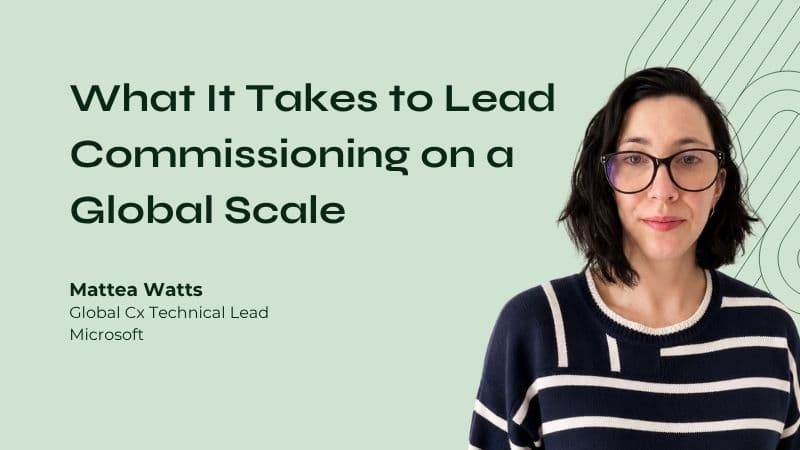
From leading commissioning on complex projects to shaping global strategy at Microsoft, Mattea Watts has built a career across engineering, operations, construction, commissioning, and global quality leadership.
As Global Cx Technical Lead, she leads global commissioning technology and process strategy for Microsoft Data Center Delivery. Her career has been shaped less by a fixed plan than by a willingness to pursue interesting opportunities.
For Mattea, career progression has never followed a fixed route. Her background spans mechanical engineering, operations, construction, commissioning, and global quality leadership. Across those roles, one thread has remained consistent: openness to opportunities that feel interesting, challenging, and useful.
The same thing that drew me to commissioning is the same thing that drew me to each role that I’ve had. My career has been shaped by a radical openness to what I find available and interesting. Whenever I encounter an opportunity that captures my interest, I go all in.
In this interview, Alexander Karhunen speaks with Mattea about career progression, leadership, commissioning, data-driven decision making, and the lessons she has learned from working at the intersection of construction and operations.
Building a career through curiosity
Alexander: How did moving into commissioning support your career progression, and what helped you step into a more senior role?
Mattea entered commissioning while working as a Senior Mechanical Engineer at Intel, where she was responsible for integrating new equipment into live R&D facilities. That experience showed her how commissioning connects construction, engineering and operations.
“A good way to excel and seek seniority is to apply for a role one level above the job you currently hold. I saw that opportunity, plus the chance to work with multiple complex systems and their interfaces versus solely mechanical systems and the boundaries that were inherent to mechanical systems.”
Before applying, there was an assumption Mattea would need expertise across every discipline. Instead, she learned the role was more about leading the commissioning process rather than being the technical expert in every system.
“The most intimidating part initially when thinking about it was, okay, well, I’m a mechanical subject matter expert, but I don’t really know much about electrical engineering, chemical systems, or controls. What I learned is that you don’t have to be an expert in all the systems. You have SMEs that you interface with, and your job is to manage the commissioning process.”
The skills that transfer across industries
Alexander: What skills carried over the most into commissioning and working with critical facilities?
“The common thread is really just methodical problem solving and what I would just call project management. It might not be formal project management, like you see roles for project managers, but everyone does project management and everything that you do in your role is a project to some degree. Methodical problem solving, I would say, is the transferable skill there.”
Progress does not always equal performance
Alexander: Is there a lesson you had to learn the hard way on a project?
“Not all progress is equal.”
Mattea believes progress metrics only matter if they reflect what's actually driving the project.
“The number of tags that are completed per day, per week, per month, that alone doesn’t tell the story because you can have a whole bunch of tags that get completed for items like those distribution segments or components. But there could be only one single tag for a crucial piece of head-end equipment or critical path, like a linchpin system.”
“Those distribution tags, even if there’s 50 of them, they don’t tell the story of that single piece of head-end equipment feeding them. If you’re not measuring and monitoring the right progress, you won’t see the constraints or the problems until it’s too late for a schedule impact.”
Success is measured by clarity, not perfection
Alexander: How has your definition of a successful project changed throughout your career?
“When I was in operations, I thought success, from an integrating equipment perspective, meant turnover with zero defects and 100% documentation.”
“It’s not about is every defect corrected. It’s the ones that impact the safe, reliable operation of the equipment corrected, right? You might have a defect that’s logged against the project that’s for a scratch in the side panel of a piece of equipment. That’s not critical.”
The key measure of success is whether the customer fully understands what they are receiving. That is where Mattea draws a clear distinction between satisfaction and successful turnover.
“Does your customer understand the exact status and configuration of the systems that they’re receiving, whether they think it’s ideal or not? Your customer being happy isn’t the measure of success. Your customer understanding exactly what they’re getting, that’s success.”
Why clarity matters more than consensus
Mattea recalled a semiconductor project where an unusual delivery structure made defect ownership difficult to define. Disputes between contractors, commissioning agents and operations teams began to affect the schedule, so Mattea brought everyone together to agree a way forward.
“It was a very non-standard, I would say, for industry non-standard structure. We had to have a large face-to-face meeting with all of the personnel involved. Everyone had to be looking at each other, not distracted on a video call, and coming to that agreement in the room. We didn’t leave until there was alignment. Nobody was thrilled, but everyone understood how it had to be.”
“You have to be okay with making a decision and driving that decision based on contractual terms and letting people not be happy, but understanding that clarity is kindness. Happiness isn’t kindness. Clarity is kindness.”
“I even had a member of that general contractor tell me almost a year later, he respected that I was the commissioning manager, but he sure hated having me in that role. Thank you, I think.”
Leadership changes as responsibility grows
Alexander: How has your leadership evolved as you’ve moved from technical roles into leading global initiatives?
“I developed a more nuanced understanding of what it meant to accomplish work. It’s more important to the overall outcome for people to feel ownership than it is for everything to be exactly the same or for everything to be done my way.”
“As a technical SME, you have the ability and freedom and it is actually your job description to make a decision and execute in the way that you feel is best. As a leader with responsibility for global initiatives, you have a lot more stakeholders and you need to let people have that ownership. It’s more important for the outcome to be aligned than it is for the execution to be uniform.”
Data only becomes valuable through interpretation
Alexander: What role should data interpretation play as commissioning and quality become more digital?
“I think interpretation becomes even more crucial the more data we have at our fingertips.”
“I have always felt like a particular strength and way that I have progressed in my career is looking for the data source and making sure that I understand it and its limitations. If I can’t own it, I will at least own the KPIs and be as close to it as I possibly can because data is power.”
“You have to control the narrative that that data is weaving. Between your problem-solving capabilities and knowledge of the subject matter and that data ownership and any KPIs you have, you can tell the story you need to tell to drive whatever change you need to drive.”
“If all you have is data and you rely on a system to tell the story for you, you’re allowing the programmer to tell the story for you. And that programmer, I guarantee you, knows nothing about your business function.”
Advice for engineers building their careers
Alexander: What advice would you give to someone early in their career?
“Don’t wait to be noticed. No one else is going to care more about your career than you do. Even a manager who thinks you’re great, they’re going to care about what your career and your skills can do for their team.”
“Track your own impacts and make sure that you stay aware of where value is being created. Whatever company you’re in, stay close to where the money is made, no matter where you work.”
For Mattea, that also means connecting with people whose work interests you.
“In semiconductor, we always used to say, you have to stay as close to the wafer as possible because that’s where the money is. Notice who’s doing work that interests you and connect with them. Those kinds of initiatives really compound quickly.”
Better questions create better leaders
Alexander: How has your life coach training influenced your work?
“It sharpened how I lead because I focus more on understanding how people actually work, not just how systems are designed. Using questions to challenge assumptions and surface better solutions.”
That focus on people has also shaped how Mattea approaches career transitions and organisational dynamics.
“Wanting to understand what motivates people and that curiosity leads to better questions and better questions lead to better outcomes. I think it’s made those career transitions and new job pivots easier because I pay more attention to social structures, power structures, beyond the hierarchy. It is never about the hierarchy.”
A career shaped by curiosity, clarity, and ownership
Mattea's career shows that commissioning combines technical expertise with leadership, communication and data-driven decision making. Her progression from mechanical engineering to Microsoft also highlights the value of curiosity, ownership and a willingness to pursue new opportunities.
If you're ready for your next opportunity in commissioning, QA/QC or mission-critical project delivery, LVI Associates can help. Submit your CV to connect with one of our specialist consultants.
We're always looking for commissioning and mission critical professionals to feature in Behind the Checklist. If you'd like to share your expertise and career journey, click here to take part.