November 2026Emma Nedeau6 min read
Why Senior Living Is Becoming a Major Growth Opportunity for Texas Architecture Firms
Key Takeaways
Growing demand for senior living: Texas' ageing population is driving demand for senior housing, creating long-term opportunities for architecture firms.
Limited construction and rising occupancy: Improving occupancy rates and constrained new development are creating opportunities for new projects, expansions and renovations.
Evolving design requirements: Senior living architecture increasingly combines healthcare, hospitality and residential design, requiring specialist expertise and flexible spaces.
Increasing demand for architectural talent: As the sector expands, Texas architecture firms will need skilled architects, project managers and design leaders to deliver senior living developments.
Senior living is emerging as one of the most compelling growth opportunities for architecture firms across Texas. The opportunity is not being driven by one trend alone. It reflects the convergence of continued population growth, a rapidly expanding older demographic, improving senior-housing fundamentals, limited recent construction, and changing expectations around how communities for older adults should look, feel, and operate.
Texas added hundreds of thousands of residents in 2025, while its older population continued to expand. Colliers reported that approximately 4.4 million Texans were aged 65 or older and projected that this population would rise by 23.4% over the following decade to approximately 5.6 million. The state's 80-to-84 population, a particularly relevant cohort for many senior housing models, was projected to grow by 49% over the same period.
For architecture firms, those figures point to a need that extends well beyond traditional retirement communities. The market includes independent living, assisted living, memory care, skilled nursing, affordable senior housing, continuing-care communities and age-restricted residential development. It also encompasses renovations, expansions, adaptive reuse, master planning, and the repositioning of older properties that no longer meet resident or operator expectations.
Texas is growing, and its population is getting older
Texas has long been associated with economic and population expansion, but the changing age profile of the state is becoming equally important to its built environment. The Texas Health and Human Services State Plan on Aging for federal fiscal years 2026 through 2028 describes a statewide network of programs and services intended to support older adults, caregivers and local aging-service organisations. The existence and scale of that planning framework reinforce that aging is not simply a private real estate trend. It is also a long-term public-policy and community-infrastructure issue.
Older Texans do not represent one uniform customer group. A healthy 65-year-old seeking an active-adult community has very different needs from an 85-year-old requiring help with daily activities or nursing care. That range creates multiple design markets. It also increases the importance of flexible planning, accessibility, wellness, safety, staff efficiency, and spaces that can support changing levels of care over time.
The result is a market in which architecture is closely connected to quality of life. Successful designs must provide more than beds or units. They must create environments that support independence, community, dignity, and operational performance while responding to Texas-specific factors such as climate, car-oriented development patterns, suburban growth, and regional differences in land and construction costs.
Improving fundamentals are meeting constrained supply
The demand story is being strengthened by operating fundamentals. In its first-half 2026 Texas Seniors Housing & Care report, Colliers stated that new construction starts across the Austin, Dallas, Houston, and San Antonio markets remained suppressed. At the same time, stabilised occupancy for seniors housing rose year over year to 88.7%, and average rents for seniors housing and nursing care reached all-time highs.
This combination matters. When occupancy improves while additions to supply remain limited, operators and investors have stronger reasons to evaluate expansion, renovation and future development. Architecture and planning services are required well before a new community opens, which means design firms must anticipate demand rather than wait for completed-unit statistics to confirm it.
The opportunity is not limited to a wave of immediate ground-up construction. Higher financing and construction costs can delay projects, alter phasing or place more emphasis on renovation. For firms, this favors a flexible approach that can address feasibility, programming, master planning, and repositioning as well as full design and construction administration.
Public funding broadens the market, but the distinctions matter
Some senior living and long-term-care environments in Texas do have a public-funding component. However, public support can enter a project in different ways, and it is important not to describe the entire senior living market as state-funded.
The most common distinction is between funding for a resident's care and financing for the real estate itself. Texas Health and Human Services administers Medicaid and aging programs that can support eligible older adults who need long-term-care services. Medicaid can pay for qualifying nursing-facility care, while certain home and community-based programs can support eligible people receiving services in other settings. In assisted living, public benefits may pay for covered care services without necessarily paying the resident's full housing cost, and not every community participates in Medicaid programs.
Separately, affordable senior housing developments may use public or public-private financing tools. Depending on the development, these can include federal housing programs, low-income housing tax credits administered at the state level, tax-exempt bonds, local housing authority participation, grants or other affordability incentives. These structures are different from Medicaid reimbursement and should not be treated as interchangeable.
For architecture firms, the distinction affects project delivery. A privately financed independent-living community may follow a different approvals, documentation and operating process from a tax-credit-supported senior apartment development or a facility serving Medicaid-eligible residents. Publicly supported work may come with affordability restrictions, program requirements, accessibility standards, reporting obligations or additional stakeholder coordination. Firms with experience navigating those requirements can offer meaningful value to owners and development partners.
This public and nonprofit dimension also makes the opportunity broader than luxury private-pay communities. Texas needs environments across the affordability spectrum, including housing and care options for older adults who cannot absorb escalating private-pay costs. That creates potential work for architecture firms serving private developers, nonprofit operators, housing organisations, healthcare providers and public-sector partners.
The opportunity reaches far beyond new construction
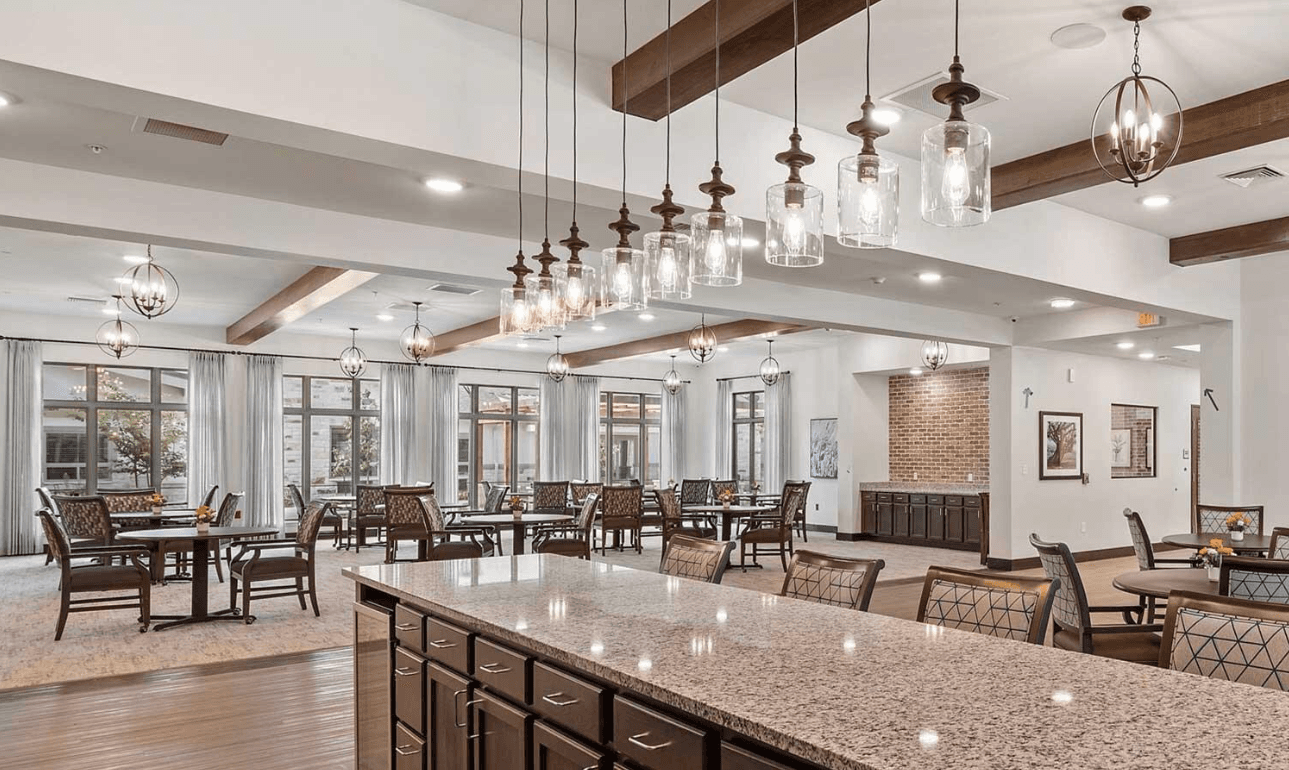
Many of the strongest near-term opportunities may be found in existing properties. Communities developed ten, twenty or thirty years ago often need modernisation to remain competitive and operationally effective. Common priorities can include updated common areas, refreshed dining concepts, enhanced outdoor spaces, improved wayfinding, accessibility upgrades, memory-care conversions, unit reconfiguration and infrastructure improvements.
Renovation can also help operators respond to a market that increasingly values choice and experience. Rather than relying on a single dining room or a limited activity calendar, newer communities often emphasize varied social settings, wellness spaces, flexible programming and stronger connections between indoor and outdoor environments.
For architecture practices, renovation and repositioning work can create lasting client relationships. A master plan may begin with a facility assessment, move into phased upgrades and later support an expansion or new building. This continuity can be particularly valuable when capital markets make large, single-phase developments more difficult to execute.
Senior living design is becoming more multidisciplinary
More demand does not mean designing more of the same product. The senior living sector increasingly overlaps with hospitality, multifamily residential, healthcare, wellness and community design. Residents and families expect welcoming environments, while operators need layouts that support staffing, security, maintenance, and care delivery.
That balance creates opportunities for firms with adjacent-sector expertise. Hospitality designers can contribute to amenity and dining experiences. Multifamily architects understand residential efficiency and unit planning. Healthcare specialists bring knowledge of clinical workflows, infection control, and higher-acuity environments. Interior designers can help create a residential identity that avoids an institutional feel.
The strongest project teams can integrate these capabilities rather than treating them as separate disciplines. They can also plan for change. Communities may need to adapt spaces as resident acuity, technology, service models or operating economics evolve. Flexible planning and thoughtful phasing can therefore be just as important as the initial visual concept.
Capital and transaction activity signal continued confidence
Investment activity provides another indicator of confidence in the sector. Colliers reported that the first half of 2026 produced the second-strongest first-half transaction volume on record for Texas, with real estate investment trusts and publicly listed buyers re-emerging as major drivers of activity.
Transactions do not automatically produce architecture commissions, but ownership changes often lead to assessments of physical condition, competitive positioning and capital needs. A new owner may invest in renovations, operational improvements, rebranding or expansion. Stronger market liquidity can also help establish valuations and return capital to groups pursuing future projects.
For architecture leaders deciding where to focus business-development resources, senior living therefore offers more than a demographic argument. Population, occupancy, capital activity, public-program participation and the need to modernise existing inventory are increasingly intersecting.
What this means for Texas architecture firms
For firms in Dallas-Fort Worth, Houston, Austin and San Antonio, senior living can become a platform for long-term practice growth rather than a single-project opportunity. Firms can serve developers and operators through site planning, programming, design, interiors, renovations, accessibility work, master planning and construction administration.
The sector also creates a distinct talent requirement. Project architects and managers need to understand residential experience, operational constraints and the needs of older residents. Senior leaders may be expected to develop client relationships, guide multidisciplinary teams and help a firm establish credibility in a specialised market.
That competition may encourage firms to recruit beyond candidates whose resumes are exclusively focused on senior living. Professionals from multifamily, hospitality, healthcare, mixed-use and residential design may offer transferable experience, particularly when they also bring knowledge of accessibility, consultant coordination, complex project delivery or client development.
Architecture firms should also consider the business-development value of public and nonprofit experience. Understanding affordable housing, Medicaid-participating care environments or public-private delivery structures can open a different set of relationships and project types. It can also help a firm contribute to one of the sector's central challenges: creating quality senior environments that are attainable for more Texans.
A durable opportunity for the Texas design market
The case for senior living in Texas is ultimately a convergence story. The state continues to grow. Its older population is expanding, particularly in age groups most relevant to senior housing and care. Occupancy has improved while new construction has remained constrained. Existing communities need modernisation, capital is returning to the sector, and public programs continue to support portions of the long-term-care and affordable-housing market.
For architecture firms, the opportunity spans both sides of the market: new capacity and reinvestment in what already exists. It includes private-pay communities, affordable senior housing, nonprofit developments, skilled-care environments and projects connected to public programs. Each requires a different mix of design, technical and stakeholder-management capabilities.
The firms best positioned to benefit will be those that treat senior living as more than a building type. It is a multidisciplinary market shaped by demographics, operations, healthcare, hospitality, affordability and community. Firms that can combine those perspectives will be well placed to design the next generation of Texas senior living.
Building the teams behind Texas senior living
As development and repositioning opportunities grow, architecture firms will need professionals who understand both the technical demands of senior living and the changing expectations of residents, developers, operators and public partners.
LVI Associates works with architecture and design firms across Texas to identify professionals ranging from architects and project managers to design leaders and senior client-facing hires. For firms looking to expand their senior living capabilities, the question is increasingly not only where the next project will come from, but whether the right team is already in place to deliver it.
Speak to our specialist recruitment team to discuss your architecture hiring requirements.