Why Ground Improvement Is Gaining Ground in Industrial Construction
October 2026Kieran Judd6 min read
Why Ground Improvement Is Gaining Ground in Industrial Construction
The growth of large-scale industrial construction across the United States is creating new opportunities for specialty foundation contractors. It could also signal a longer-term change in how these facilities are built. As developers face tight construction schedules and challenging soil conditions, ground improvement methods such as aggregate pier installation, rigid inclusions, and vibro replacement are gaining attention as alternatives to traditional deep foundations.
Kieran Judd, Associate Vice President at LVI Associates, recently predicted that ground improvement would take market share from deep foundations across industrial and data center projects over the next decade. If this happens, it could change how foundation contracts are awarded, which services contractors provide, and the skills employers look for when hiring.
How industrial construction is changing foundation requirements
Large manufacturing plants, distribution centers, and data centers often need extensive concrete floor slabs, foundations that support heavy structural loads, and stable ground for specialised equipment. These requirements become more difficult to manage when construction sites contain weak soil, inconsistent fill, or compressible ground. Engineers must consider how uneven settlement could affect building performance, equipment alignment, and long-term operations.
Site selection adds another challenge. Developers often prioritise land availability, transportation access, utilities, and power connections over favorable soil conditions. As explored in our article, Data Center Site Selection in 2026: The Constraint-First Discipline, infrastructure constraints can have a major influence on where projects are developed. Early geotechnical investigations help construction teams identify potential foundation problems, compare available solutions, and involve specialty contractors before designs are finalised.
Ground improvement techniques used in industrial construction
Ground improvement includes several construction methods used to strengthen existing soil or improve its ability to support structures. Some techniques compact loose ground, while others add reinforcing materials or stabilised elements beneath foundations. The best approach depends on soil conditions, structural loads, groundwater levels, and the amount of settlement a building can tolerate.
Comparing ground improvement methods and their benefits
| Method | How it works | Main benefits |
| Aggregate piers | Compacted columns of crushed stone or gravel strengthen weak soils. | Increase bearing capacity, improve ground stiffness, reduce settlement, and can support shallow foundations. |
| Rigid inclusions | Stiff elements, typically made with cement-based material, strengthen the ground and usually work with a load transfer platform. | Help control settlement and support heavy structural loads. |
| Vibro replacement | Specialised vibrating equipment installs stone columns in weak or loose soil. | Improves ground stability, reduces settlement, and can help with drainage and soil consolidation. |
| Vibro compaction | Vibrating probes compact suitable loose, granular soils. | Increases soil density and can reduce the risk of liquefaction. |
| Deep soil mixing | Existing soil is mixed with cement-based binders to improve its properties. | Increases soil strength and reduces compression in suitable weak soils. |
What is aggregate pier installation and how does it work?
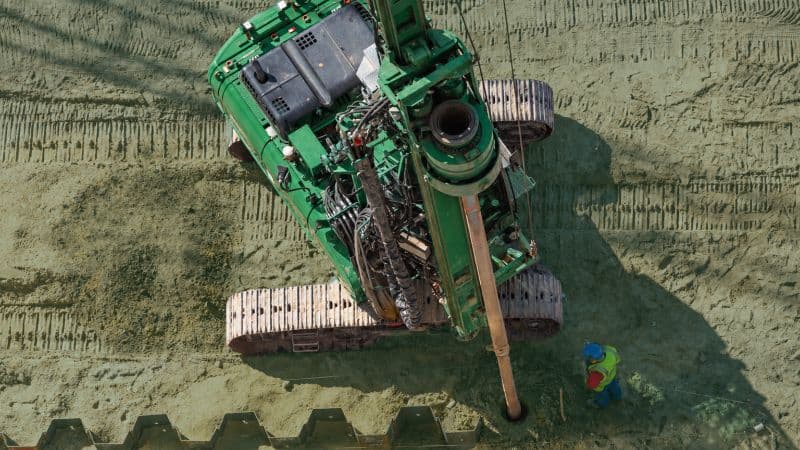
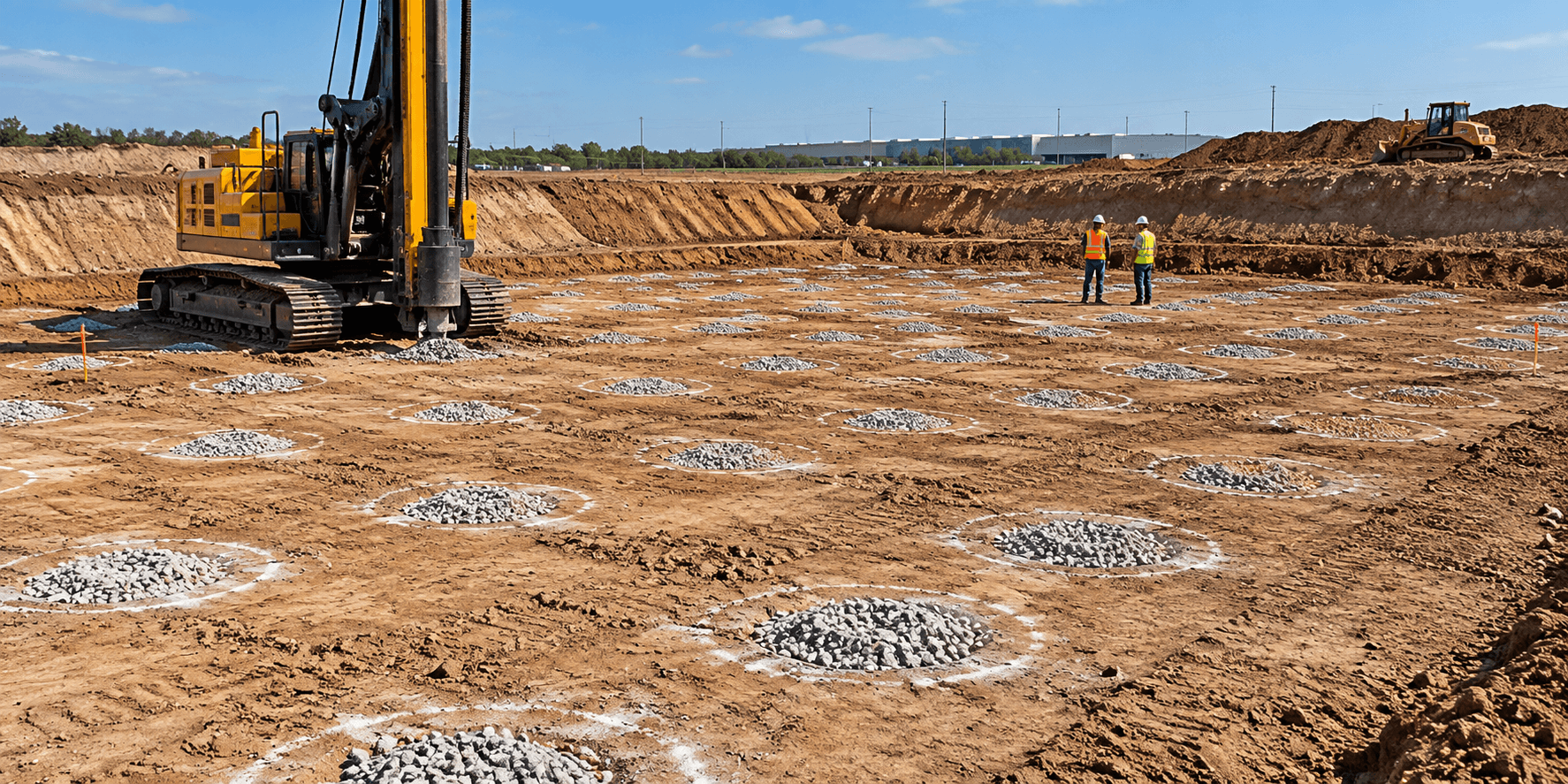
Aggregate pier installation strengthens weak or compressible soil by installing tightly compacted columns of crushed stone or gravel beneath a structure. These columns work with the surrounding soil to improve its ability to support weight and limit settlement. Where ground conditions allow, this can make shallow foundations a practical alternative to traditional deep piles.
Before installation, engineers investigate the soil to determine its strength, composition, and settlement characteristics. They use this information to calculate the required pier depth, diameter, and spacing. Contractors then use drilling or specialised displacement equipment to form the piers, placing and compacting aggregate in layers. Testing and quality checks help confirm that the completed system meets the project's design requirements.
Aggregate piers are commonly used in warehouses, manufacturing facilities, and data centers. However, they are not suitable for every site, particularly where deep layers of weak soil or demanding structural requirements call for a different approach. Engineers must evaluate the conditions of each project before selecting the appropriate method.
Ground improvement in practice: Two data center projects
Two completed projects for Facebook, now Meta, show how aggregate piers have been used to solve different foundation challenges. These examples highlight the engineering decisions behind successful installations, although they do not establish a broader shift in market share.
The Antelope Data Center in Los Lunas involved building a two-story facility with a footprint of approximately 11,150 square meters. The site contained alternating layers of sand, silty sand, and sandy silt, which required careful planning to control settlement and support the building's structural loads. According to Geopier's case study, its GP3 rammed aggregate pier system was selected instead of extensive excavation and soil replacement or auger-cast piles.
Nearly 1,800 aggregate piers were installed to depths of approximately 2.4 meters, with installation completed in 37 days. The system allowed engineers to reduce the size of the foundation footings and the amount of concrete required. Field testing also showed that pier stiffness was more than three times the specified design value. The project demonstrates how improving the ground beneath a structure can influence foundation design and reduce the amount of construction work required above it.
The Omaha project presented different challenges, with approximately 5.5 to 9.1 meters of soft to firm loess soils over harder ground. The construction team also needed significant excavation and filling to establish the final building elevations. As reported by Engineering News-Record, Geopier developed a solution using approximately 5,300 rammed aggregate piers installed to average depths of around 4.9 meters.
The project combined GP3 and X1 installation systems to address varying soil conditions, including work above and below the groundwater table. According to the published project account, the selected solution supported a faster construction schedule than the alternative deep foundation and structural slab system. This example shows how contractors can adapt installation methods to meet the engineering needs of a large industrial site.
Ground improvement vs. Deep foundations: Is the market beginning to shift?
The growing range of ground improvement methods available to engineers raises questions about how the specialty foundation market could change. Traditional deep foundations will continue to be necessary for many structures, especially when loads must pass through weak soil to reach stronger ground below. However, alternative methods may become more competitive on projects where engineered soil reinforcement can provide the required support.
In a recent LinkedIn discussion shared through the American Geotechnical Network, Kieran Judd offered his prediction for the industry:
Ground Improvement will continue to take market share from Deep Foundations on Industrial and Data Center projects over the next decade.
An accompanying LinkedIn poll received 23 votes, with 73% of respondents agreeing that ground improvement would take market share from deep foundations on large industrial and data center projects. A further 26% disagreed. While the small number of responses means the findings cannot represent the wider industry, they offer an indication of how some professionals view the future of foundation construction.
Kieran's prediction goes beyond aggregate piers. He also expects growing interest in rigid inclusions and vibro techniques compared with traditional drilled shafts. These methods work differently and have their own applications, but their wider use could change how contractors approach bids, technical proposals, and project planning.
For companies that have traditionally focused on conventional piling, changing customer requirements could create opportunities to expand into new services. However, introducing a different construction method requires investment in specialised equipment, engineering knowledge, and experienced project teams. Contractors must decide which services fit their existing operations and where there is enough demand to support expansion.
This potential change could also affect competition between established foundation contractors and companies specialising in ground improvement. As developers compare a wider range of options before awarding contracts, businesses with experience across complementary methods may be able to pursue projects that previously fell outside their core services.
How changing foundation methods are reshaping specialist recruitment
For construction employers, changing foundation methods could create hiring challenges that go beyond finding additional workers. A contractor with extensive experience in drilled shafts may already have skilled engineers, project managers, and superintendents, but expanding into aggregate piers or rigid inclusions requires knowledge of different equipment, installation methods, and technical standards. Employers need to identify which skills their existing teams already have and where additional experience is needed.
This is especially important for senior engineering and operations roles. Geotechnical engineers may need experience assessing alternative foundation designs, while project managers must understand how different installation methods affect equipment requirements and construction schedules. Superintendents and field engineers also need practical knowledge of site procedures, installation monitoring, and quality control. Finding candidates who combine these technical skills with leadership experience can make some positions difficult to fill.
However, employers do not necessarily need to recruit only from companies using identical construction methods. Professionals working in deep foundations, earth retention, ground stabilisation, and heavy civil construction often have experience managing specialised equipment and complex projects. Through our work in geotechnical recruitment, we recognise the importance of understanding how those skills can transfer into different areas of foundation construction.
Kieran Judd, Associate Vice President at LVI Associates, comments:
As contractors expand into different ground improvement methods, I think the hiring challenge becomes more about identifying technical adaptability than matching someone to an exact job title. There are experienced people across deep foundations and heavy civil construction who could make that transition, but employers need to understand where their existing experience is transferable and where additional technical support is required. The companies that assess that properly will have more options when building their teams.
For employers, the priority is understanding which skills can transfer between construction methods and which require additional training. An experienced piling superintendent may already be capable of managing complex site operations but may need technical training before overseeing aggregate pier installation. Similarly, a geotechnical engineer with direct ground-improvement design experience may be well suited to helping a contractor develop a new service, even without extensive operations-management experience. Assessing candidates against the actual requirements of each position can help employers make better hiring decisions and develop talent internally.
The future of specialty foundation construction
The next decade could see ground improvement play a larger role in industrial construction, changing the types of projects available to specialty contractors and the experience required to deliver them. While traditional deep foundations will remain an important part of the industry, growing interest in alternative methods may create opportunities for businesses with expertise across multiple techniques.
Build the expertise your next project needs
As industrial construction changes, finding experienced engineering and construction professionals can make a significant difference to project delivery and business growth. At LVI Associates, we connect specialty foundation and geotechnical engineering contractors with project managers, superintendents, technical engineers, and senior leaders who understand the requirements of complex construction projects.
Looking to strengthen your team? Contact our specialist recruitment team to discuss your hiring needs and how we can support your next project.