

July 20267 min read
AI’s Next Constraint Isn’t GPUs, It’s the Grid
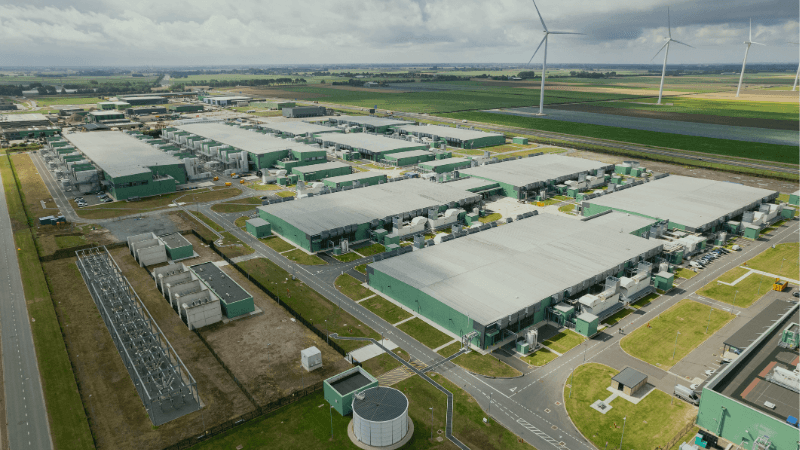
Data center power demand has become one of the defining constraints in AI infrastructure. Meta’s new 1GW data center in Alberta, its first in Canada and representing more than CAD $13 billion in investment once complete, has made headlines as a cloud compute story, especially alongside reports that they may rent excess AI compute capacity to outside customers.
But an even bigger story sits underneath the servers: the power required to bring AI infrastructure online at scale before grid constraints slow the market further.
AI infrastructure is becoming an energy infrastructure race
Meta’s Alberta project is tied to power infrastructure on a scale that will mark a turning point in how the market views AI expansion. This is not a data center relying only on existing grid capacity – instead, major generation infrastructure is being developed around it.
Pembina Pipeline, Morgan Stanley Infrastructure Partners, and Kineticor have announced they are moving ahead with the Greenlight Electricity Centre, a 932MW natural gas-fired power plant in Sturgeon County. The CAD $4.6 billion facility is expected to enter service in the second half of 2030 and will provide dedicated power to the project under a long-term agreement.
This is the infrastructure pattern likely to define the next phase of AI data center buildouts. As these projects place larger, faster, and more concentrated demands on the grid, developers, utilities, and infrastructure investors are being forced to rethink how power is sourced, connected, and delivered. EPRI’s 2026 Powering Intelligence report projects that US data centers could consume 9% to 17% of national electricity by 2030, with AI workloads already accounting for an estimated 15% to 25% of data center electricity consumption today.
The International Energy Agency has also identified AI, data centers, advanced manufacturing, and electrification as major drivers of renewed electricity demand growth in advanced economies after a long period of stagnation.
This is why the next phase of AI growth will depend on securing power generation, grid interconnection, land, water strategy, permitting, and community acceptance quickly enough to get facilities live – all of which requires highly specialized talent.
Grid and power access are now talent challenges
The energy infrastructure demands behind AI data centers are creating talent pressure across the industry.
Lucy Loomes, Director – Head of Data Center Recruitment at LVI Associates, explains:
AI is now the largest driver of data center demand across the full life cycle of projects, and that’s resulted in a sharp rise in requests for professionals who have already delivered AI data center facilities – a change from recent years where firms have been happy to borrow skills from adjacent industries.
That experience matters because AI data centers are larger, more complex, and more power-intensive than many traditional facilities. They also need to be delivered at speed, with hyperscalers and developers racing to bring new capacity online to meet surging AI demand.
None of these projects can move forward without first securing the land, power, grid connections, cooling strategy, and technical delivery expertise needed to support them, leading to fierce competition for professionals across:
- Grid interconnection engineering
- Transmission and distribution planning
- Substation engineering
- Power generation development
- Utility coordination
- Energy permitting and regulatory approvals
- Power procurement and energy strategy
- Utility-scale project management
- Land acquisition and site selection
- Environmental planning and water strategy
- Data center electrical and mechanical systems
- Mission-critical construction management
- Community engagement and public affairs
- Critical facilities operations
Why energy and grid talent is becoming harder to secure
Simply, AI infrastructure projects are moving faster than the talent pool can grow.
Loomes describes current hiring conditions as unlike anything she has ever seen, adding that even though firms say having enough money to secure talent isn’t an issue, finding the right experts deliver the work is, which is impacting compensation and hiring strategy regardless.
According to Loomes:
Some companies are paying salaries 50% higher than others for similar skill sets, because they need experienced professionals quickly. Even candidates with limited data center experience can command a premium because experience is so scarce.
For hiring managers, this creates several risks:
- Compensation benchmarks can date quickly in grid, power, and data center infrastructure roles.
- Candidates with large-load, utility, or mission-critical experience often have several active options.
- Slow interview processes lose talent to faster-moving developers, utilities, or hyperscalers.
- Offers without clear project value, power strategy, progression, or long-term upside struggle to compete.
- Firms entering the AI infrastructure market need credible grid, power, and delivery leaders before they can scale teams.
- Permitting, community, and utility coordination issues can delay projects even when construction teams are in place.
Loomes also notes that equity is a rising factor in candidate decision-making:
Historically, equity was more common in senior executive appointments. In today’s AI infrastructure market, some firms are using equity, RSUs, and enhanced bonus structures to compete for professionals.
Not every company can offer equity. But every company needs to understand its position in the market. Firms that cannot compete on equity or top-of-market base salary need to sell stability, project pipeline, autonomy, speed of progression, and the strategic value of the work. Speak to our team to discuss how your hiring strategy compares and where you can gain a competitive advantage.
Permitting and community acceptance can also delay power delivery
Grid capacity is not the only constraint. As mentioned previously, AI infrastructure projects also need permitting approval, water strategy, environmental planning, and community acceptance before they can progress, which requires proving local value.
Large data center and power projects are increasingly facing public scrutiny around electricity use, water, emissions, land use, traffic, noise, and local disruption, and Loomes sees community pushback as one of the biggest emerging issues in data center development.
She notes that companies are becoming more cautious about how they announce projects and are increasingly focused on job creation, local revenue, and community impact rather than only project size or capital investment. Meta's Alberta facility, for example, is expected to use closed-loop dry cooling technology to reduce water use and includes commitments to additional local infrastructure investment.
As a result, community engagement, permitting, regulatory, environmental, and public affairs talent will become more important to power and data center project delivery. Without those skills, projects can face significant delays even when funding, land, and technical teams are in place.
Learn more in our article: Why Early Community Engagement is Now Critical for Data Center Development
What grid, power, and infrastructure hiring managers should do next
For firms planning data center, power generation, or utility-scale infrastructure projects, the following five priorities can help address talent challenges, reduce project risk, and improve delivery timelines:
1. Map grid and power talent early
Identify interconnection, substation, transmission, generation, and utility coordination specialists before hiring becomes urgent. The most in-demand candidates may not be actively looking, but they are often open to the right project, leadership team, and long-term opportunity.
2. Use current compensation intelligence
Active hiring intelligence matters in fast-moving AI infrastructure roles, especially when candidates are comparing offers from developers, utilities, hyperscalers, and infrastructure investors. Request a call back from LVI Associates to discuss the local talent market and compensation expectations for your specific vacancies.
3. Move quickly on high-demand candidates
Professionals with grid, power, and mission-critical delivery experience are unlikely to wait through slow interview processes. Structured interviews in as few rounds as possible, as well as fast feedback and decision-making, can be the difference between securing talent and losing it.
4. Sell the full project proposition
Candidates want to understand project funding, power strategy, permitting status, career progression, and long-term stability. The strongest offer is not always the highest base salary. It is the offer that gives candidates confidence in the project and their role in delivering it.
5. Hire beyond technical delivery
Community engagement, permitting, environmental, and regulatory talent can protect timelines as much as engineering talent. Firms that treat these roles as secondary may expose projects to avoidable delays.
As part of Phaidon International, learn how LVI Associates and our partner brands provide end-to-end data center talent solutions across energy & infrastructure, technology, supply chain, financial sciences & services, and regulatory & legal industries through a single partnership.
What this demand means for grid, power, and infrastructure professionals
For professionals working in data center power, grid, utilities, and infrastructure development, AI is creating new routes into high-growth projects.
Loomes notes that many professionals are exploring the market for compensation growth and exposure to developments that may not be available once the industry matures.
But with such significant opportunities available, choosing the right role matters. Assess the full proposition before committing to a move, including:
- Project funding and commercial viability
- Power supply and grid interconnection strategy
- Utility relationships
- Permitting status
- Leadership experience
- Workload and delivery expectations
- Compensation structure and equity terms, if offered
- Long-term career path
Hire the grid, power, and infrastructure talent behind AI growth
LVI Associates supports organizations hiring specialist grid, power, and energy infrastructure talent for AI data center projects, from site selection, grid strategy, power generation, and utility coordination through to development, construction, and operations.
Whether you need support with talent mapping, compensation intelligence, search strategy, or access to hard-to-find active and passive specialists, request a call back to discuss your critical hiring requirements.
For professionals in the field considering their next career move, access exclusive opportunities across data centers, power infrastructure, and mission-critical projects with LVI Associates. Browse open roles here, or register with us to upload your resume and create unlimited job alerts so you never miss a new opportunity.
Let’s talk talent
Request a call back and one of our experienced consultants will get in touch to discuss your hiring requirements.
Advancing your career
Want to be one step ahead in your career? Our industry experts have the relationships and global reach to realize your full potential.