

November 2025Alex Hayes
Underwater Data Centers: Innovation or Environmental Risk?

As demand for cloud computing and AI continues to grow, so does the environmental cost of keeping the digital world online. Data centers currently use between 240 and 340 terawatt hours (TWh) of electricity each year, about 1 to 1.3% of global electricity consumption, according to the International Energy Agency (IEA). They also consume large volumes of freshwater for cooling.
To reduce this footprint, some engineers are looking underwater. Underwater data centers, designed to use cold seawater as a natural cooling system, could significantly lower energy consumption and free up land for other uses. Yet the concept raises new questions about marine ecology, maintenance, and long-term viability.
How underwater data centers work
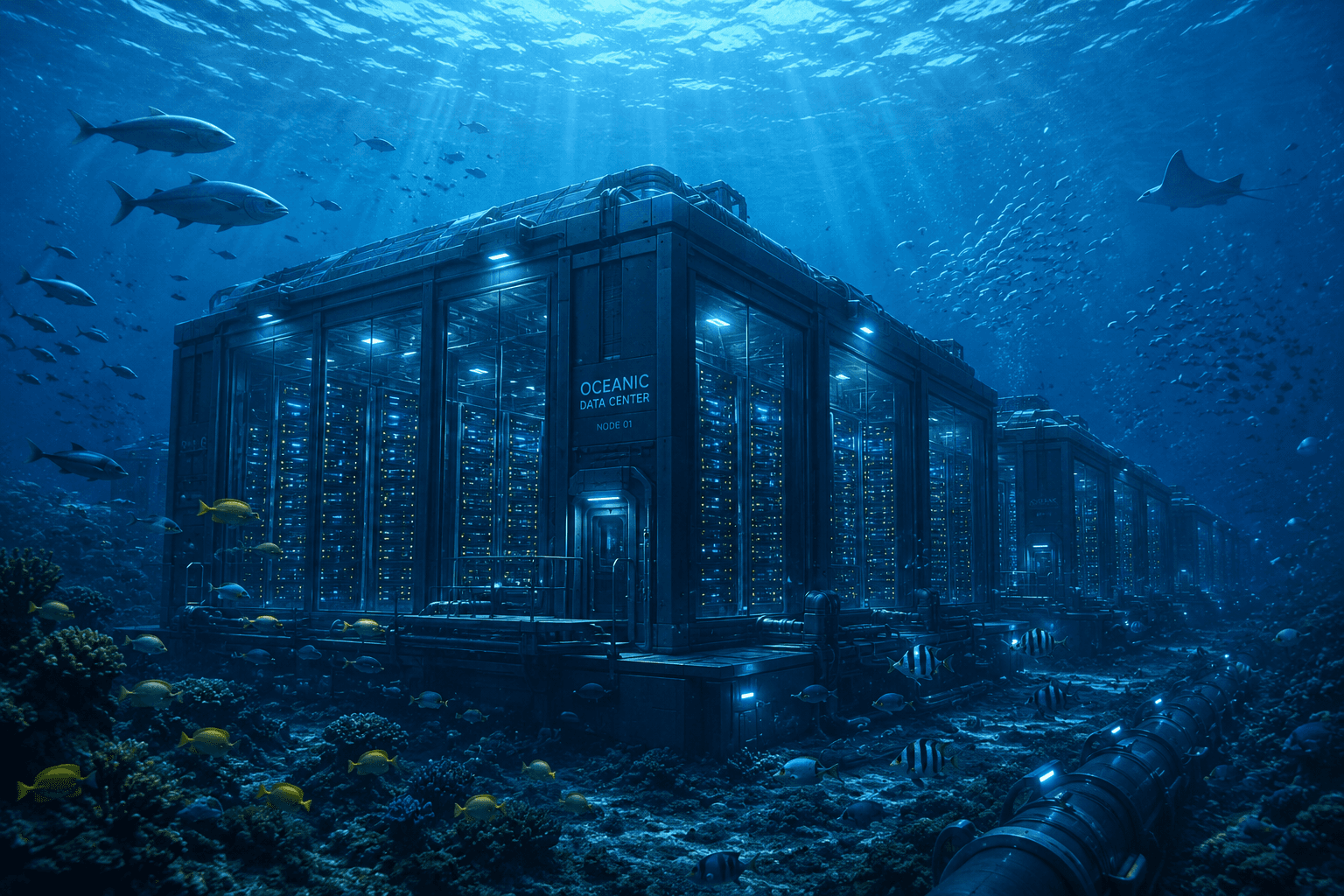
An underwater data center is a sealed capsule filled with servers and communication equipment, connected to the mainland through power and fiber optic cables. The surrounding water acts as a passive cooling system, removing the need for traditional air conditioning, which can account for 45% of a data center’s total energy use. Microsoft’s Project Natick, launched in 2018 off the coast of Scotland, remains the most studied example. The unit, submerged 36 meters underwater, housed 855 servers. After two years of operation, only six failed, a 0.7% failure rate compared with 5.9% in a similar land-based test. The stable underwater environment appeared to improve reliability and reduce maintenance.
Global projects and developments
Interest in underwater data centers has expanded worldwide. In China, Highlander Digital Technology has developed underwater facilities near Hainan Island and Shanghai, with projects exploring how seawater cooling can reduce the energy required to operate data infrastructure.
In May 2026, the Shanghai Lingang underwater data center entered operation around 10 km off Shanghai’s coast. The first phase has a capacity of 2.3 MW, while the wider project has a planned capacity of 24 MW. The facility is directly connected to offshore wind power and uses seawater for cooling, providing a significant test of how underwater infrastructure could support growing AI and computing demand.
In the United States, a startup called NetworkOcean has proposed a pilot in San Francisco Bay, though regulators have raised environmental concerns. Across Northern Europe, smaller feasibility studies are exploring ways to connect underwater data storage to offshore wind farms, creating renewable-powered cloud infrastructure.
Market analysis suggests that the global underwater data center industry could grow from USD 1.5 billion in 2024 to more than USD 6 billion by 2033, driven by the need for energy-efficient digital infrastructure.
Potential environmental benefits
Advocates believe underwater data centers could make digital infrastructure more sustainable. By using the ocean’s naturally cool environment, these systems reduce the need for traditional air conditioning, which is one of the biggest energy drains in land-based facilities. The stable underwater temperature also helps maintain consistent performance and reduces stress on equipment.
Because they operate offshore, underwater data centers take pressure off land and freshwater resources and can be positioned near renewable power sources such as wind or tidal energy. If developed responsibly, they have the potential to lower emissions and contribute to the industry’s shift toward cleaner, more efficient data infrastructure.
Challenges and controversy
Environmental impact on marine ecosystems
Despite their potential, underwater data centers remain controversial. Marine scientists warn that temperature increases in coastal waters can affect local ecosystems. Many marine species rely on stable temperatures for breeding, feeding, and migration. If large numbers of submerged facilities released heat into coastal waters, researchers fear this could create localized thermal pollution that alters biodiversity and affects marine food chains. There are also concerns around underwater noise, electromagnetic fields from power cables, and physical disruption to seabed habitats during installation.
Environmental assessment is also becoming a more formal part of the discussion. In 2026, the International Telecommunication Union began work on a sustainability evaluation framework for data centers that use natural surface water for cooling. The proposed framework considers thermal pollution, water quality, biodiversity, biofouling, corrosion, and ecological disturbance. The work remains under development, showing that standards for measuring the environmental impact of water-cooled data infrastructure are still evolving.
Corrosion, biofouling, and maintenance challenges
The ocean itself creates major engineering challenges. Saltwater is highly corrosive, so infrastructure must be built using specialized materials and protective coatings. Over time, marine organisms such as barnacles and algae attach themselves to submerged structures, a process known as biofouling. This can reduce cooling efficiency, damage equipment, and increase maintenance requirements. Unlike land-based facilities, underwater systems are difficult and expensive to access. If hardware fails, operators may need ships and lifting equipment to retrieve entire data pods from the seabed.
Pressure and operational reliability
Pressure is a major challenge for deep-sea equipment. As depth increases, water pressure rises sharply and places constant stress on structures, seals, cables and sensors. Even small weaknesses can lead to serious failures when systems operate under extreme pressure for long periods.
The failed Titan submersible operation in June 2023 shows this risk clearly. Titan was diving to the Titanic wreck when its pressure hull failed and the vessel imploded. The incident shows why deep-sea systems need strong materials, rigorous testing and clear safety processes.
This links to space, although the pressure challenge works in the opposite direction. In the deep sea, equipment must resist external pressure pushing inwards. In space, equipment operates in a near-vacuum, so spacecraft and space habitats must manage internal pressure pushing outwards.
Because of this, it may be more likely that humans build large, reliable structures in space before permanent deep-sea settlements. The LVI Associates article, Building Data Centers in Space and What It Reveals About Pressure on Earth, shows how space-based data centers are already being explored as a response to pressure on Earth’s infrastructure, including energy demand, land limits and AI-driven computing.
Space still has major challenges, including radiation, temperature changes and launch costs. However, deep-sea construction faces crushing pressure, corrosion, darkness and difficult repair access. In both environments, operators must rely on remote monitoring, automation and backup systems because direct maintenance is limited.
As a result, reliability becomes central to design. Equipment must be tested before deployment, built with suitable materials and designed to keep working if one part fails. These costs are high, but they reduce the risk of failure in environments where repairs are difficult or impossible.
Why Microsoft ended Project Natick
Microsoft’s Project Natick demonstrated that underwater data centers could work technically. The company reported lower server failure rates and improved cooling performance during trials off the coast of Scotland. However, Microsoft ended the project in 2024 after concluding that large-scale deployment would be difficult to commercialize. The main problem was economics. Building and deploying underwater facilities required specialized marine engineering, offshore installation vessels, and complex grid connections, making costs far higher than conventional data centers.
Maintenance also conflicted with the fast upgrade cycles used in cloud computing. Land-based facilities allow operators to replace servers continuously, but underwater systems are largely sealed once deployed. Any repair or upgrade becomes slow and expensive. Suitable locations are also limited because underwater facilities need access to coastal power infrastructure while complying with environmental and maritime regulations.
However, Microsoft’s decision did not bring development of underwater data centers to an end. China’s Shanghai Lingang project entered operation in 2026, showing that developers are continuing to test alternative commercial models. Its combination of underwater computing, seawater cooling and direct offshore wind power also suggests that future projects may be developed alongside renewable energy infrastructure rather than as standalone data centers.
Regulatory and legal barriers
Regulation remains another major obstacle. Offshore zones are tightly controlled in many countries because they overlap with shipping routes, fishing industries, military activity, renewable energy projects, and protected marine environments. Companies must pass environmental assessments and comply with maritime, energy, and planning regulations before deployment, which can slow projects for years.
Rising energy consumption in Europe
At the same time, governments are becoming increasingly concerned about the energy demands of modern data infrastructure. In Europe, projections suggest data centers could consume around 150 TWh of electricity by 2030, close to 5% of total continental power demand. The rapid growth of AI is accelerating this trend because advanced AI systems require dense clusters of GPUs running continuously, alongside intensive cooling systems. Some analysts argue underwater facilities may improve cooling efficiency, but they do not solve the larger problem that global computing demand continues to rise faster than efficiency gains.
Shift toward alternative solutions
As a result, most major technology firms are now focusing more heavily on alternatives such as liquid-cooled land data centers, renewable-powered facilities, modular AI infrastructure, and even nuclear-powered energy partnerships, rather than pursuing large-scale underwater deployments.
What could underwater data centers mean for salaries?
The development of underwater data centers could intensify competition for an already limited pool of specialist talent.
Traditional data center projects already compete for experienced electrical and mechanical engineers, construction leaders, commissioning specialists and operations professionals. Underwater facilities may require many of these same skills alongside expertise in marine engineering, offshore power systems, corrosion management, subsea infrastructure and environmental compliance.
As projects move towards commercial deployment, employers may increasingly compete for talent across the data center, offshore energy and marine engineering sectors. This could put additional pressure on salaries for professionals with relevant technical experience.
Salary benchmarks currently focus on conventional above-ground data centers, but they provide a useful picture of how competitive the wider talent market already is.
A balanced outlook
Underwater data centers are sparking debate about how technology can evolve responsibly. The experiments show promise in reducing energy use and improving cooling efficiency, while raising questions about long-term ecological effects.
Alex Hayes, Executive Director at LVI Associates said:
The debate around underwater data centers reflects a broader challenge in the technology sector: how to balance innovation with environmental responsibility. The concept demonstrates how creative engineering can reimagine energy use, but it also highlights the importance of considering long-term ecological effects. Even if widespread deployment remains uncertain, the research and design advances emerging from these experiments, particularly in cooling efficiency and renewable integration, are already influencing how traditional data centers are built and operated.
Partnering to build sustainable data center infrastructure
For organizations developing or expanding digital infrastructure, the move toward sustainable design requires expertise that spans engineering, renewable energy, and environmental science. Building greener data systems, on land or under the sea, demands collaboration between specialists who understand both performance and environmental impact.
LVI Associates partners with companies across the energy, data, and environmental sectors to help them hire professionals who can design and manage sustainable infrastructure for the future.
If your organization is exploring new data infrastructure projects and needs the right technical and environmental expertise, request a call back from LVI Associates to discuss your hiring needs.

Frequently asked questions about underwater data centers
Microsoft designed its Project Natick module to operate without maintenance for up to five years. The concept relied on sealed, remotely monitored infrastructure rather than regular human access. Microsoft also planned for the vessel itself to have a much longer lifespan, with retrieval and replacement of the computing hardware between deployment cycles.
Underwater data centers can be designed for retrieval rather than permanent abandonment on the seabed. Microsoft’s Project Natick concept involved recovering the module, replacing the servers and eventually recycling the vessel and its components. The seabed around the deployment site was also intended to be restored after removal.
Potentially. Locating computing infrastructure closer to densely populated coastal areas could reduce the physical distance data must travel between users and servers. However, latency also depends on network architecture, fiber connections and where workloads are processed, so placing a data center underwater does not automatically make services faster.
Yes, this is one of the models now being explored. Locating data centers near offshore renewable generation could give operators direct access to electricity while seawater provides cooling. The Shanghai Lingang project is an example of underwater computing infrastructure being developed alongside offshore wind power.
Microsoft designed Project Natick around rapid deployment, with its full-scale prototype capable of moving from manufacture to operation in less than 90 days. Modular construction could make deployment faster than building some conventional data center facilities, although commercial projects still require offshore engineering, grid connections and regulatory approval.
Yes. AI workloads require large amounts of computing power and cooling, which makes energy-efficient infrastructure increasingly important. China’s Shanghai Lingang underwater data center is being developed in part to support AI computing demand, although underwater facilities remain a small part of the wider data center market.