

Behind the Checklist: Commissioning Careers, Featuring Larry Ollice
May 2026Alexander Karhunen3 min read
Behind the Checklist: Nuclear Submarines to Data Center Commissioning Featuring Larry Ollice
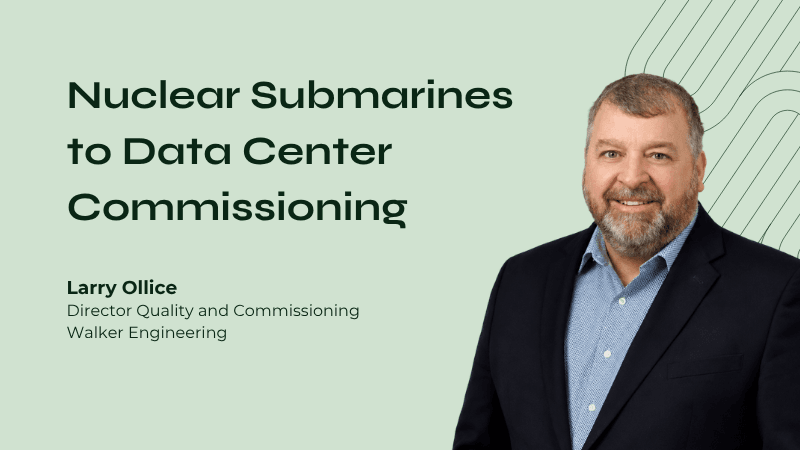
Careers in commissioning rarely follow a straight path. Progression is shaped by technical experience, exposure to different stages of a project, and the environments professionals work in over time.
To better understand how those careers develop, LVI Associates speaks with commissioning professionals across the industry, sharing lessons from people working at a senior level across mission-critical infrastructure, manufacturing, and construction.
In this interview, Alexander Karhunen, Consultant at LVI Associates specializing in commissioning and mission-critical hires, speaks with Larry Ollice, Director at Walker Engineering. With experience spanning nuclear submarines, data centers, third-party commissioning and construction, manufacturing quality, and electrical construction, Larry brings a practical perspective on what drives long-term success in commissioning.
Today, Larry oversees both quality and commissioning on complex projects at Walker Engineering. His route into the industry, however, was far from conventional.
After 30 years in the Navy working on nuclear-powered submarines, he transitioned into data center commissioning and quickly realized the work was more familiar than he expected.
From nuclear submarines to data centers
Alexander: What first got you into commissioning, and what drew you to it over other engineering paths?
“We actually had a checklist that we do every week, where we’re testing all aspects of the nuclear power plant to make sure that it functions properly. We didn’t call it commissioning at the time, but that’s what we were doing.” Larry explains that commissioning principles were embedded throughout his Navy career long before he formally entered the industry.
That mindset translated directly into mission-critical infrastructure. Submarines and data centers both operate in environments where downtime is unacceptable.
“A submarine is a mission-critical platform. When you’re at 800 feet under the water and you’re moving at 20 knots, the lights are not allowed to go out. Submarines are designed, built, tested, operated, and maintained, just like a data center. The principles are the same. Commissioning becomes a natural skill set.” Larry continues.
The parallels between the two industries became obvious once he entered the civilian sector. Both rely on redundant power systems, structured testing, operational discipline, and rigorous quality standards.
At its core, he sees commissioning as a process of verifying that systems perform exactly as intended.
“You read the specification, sequence of operations, and drawings. From those documents, you figure out when it’s supposed to turn on, when it’s supposed to turn off, does it ramp up or down, and how it should behave. It’s a whole series of questions. Then you build a checklist that tests all of that.”
Commissioning as a cost, versus commissioning as protection
Alexander: How have you seen commissioning change over time, and where is the industry heading?
“In most cases, commissioning has been commoditized. It becomes the cheapest option, whoever bids the lowest wins the contract. The problem is you can’t do it properly at that level. It takes time, effort, and people who know what they’re doing.”
Over time, Larry believes the industry has split into two very different approaches.
In traditional commercial projects, commissioning is often treated as a compliance exercise and heavily cost-driven. That often leads to what he describes as “check-the-box commissioning”, where the focus is on completing documentation rather than fully validating system performance.
Mission-critical environments operate differently. Data center owners understand the financial consequences of failure and treat commissioning as a core part of delivery.
“They value commissioning greatly because they know that that's how they ensure their data center is working properly. If it doesn’t, they lose millions of dollars a minute.” Larry continues.
That difference in expectations has helped raise standards across the mission-critical sector and increased demand for experienced commissioning professionals.
Why technical experience matters
Alexander: What advice would you give to someone looking to enter or progress in commissioning?
“The best commissioning agents are those who were technicians first.”
He believes the strongest commissioning engineers come from practical field backgrounds, particularly in electrical systems, HVAC, controls, or building automation systems. When asked what separates strong commissioning professionals from the rest, Larry points directly to hands-on technical experience.
"Explaining that you need to understand how and why the equipment works and what they're actually doing, not just what they look like on paper. That experience becomes especially important when reviewing drawings, building test scripts, and diagnosing failures during live testing."
If you don’t understand the drawings and the equipment, it’s going to be hard to build proper test scripts and validate systems the right way.
While engineering theory has value, Larry argues that commissioning is ultimately learned through exposure to real systems, troubleshooting, and field operations.
He also sees adjacent technical roles as strong entry points into the field, particularly for electricians, controls technicians, MEP coordinators, and engineers with real project exposure.
One of the defining parts of Larry’s career has been working across multiple sides of the industry, including third-party commissioning, manufacturing, contractor operations, and general contractor delivery. That experience changed how he viewed project teams and accountability.
Learning leadership from every side of the industry
Alexander: How has working across different parts of the industry shaped your leadership approach?
“To me, the GC was a four-letter word. I didn’t have a good perception of them at all.”
That perspective evolved once he moved into a role responsible for project delivery.
“When you’re on the GC side, you own it. It's your responsibility to make sure it's all done right. You may not be fixing it yourself, but if it's broken, it comes back to you.”
Rather than simply identifying issues, the responsibility becomes coordinating subcontractors, vendors, and commissioning teams to solve problems and move projects forward.
Over time, that experience influenced his leadership style.
“I learned more of a team aspect of it. We’re all on the same team. In the end, the goal is to deliver this product to the client. If any one group fails, the whole team fails.”
Larry also became more focused on supporting teams directly, spending time with different groups onsite to understand challenges and remove blockers instead of approaching problems from a purely oversight perspective.
Building career paths through training and qualification
Alexander: Do you think the industry does enough around mentorship and development?
Larry believes structured development remains one of the biggest gaps in commissioning today.
Drawing from both Navy and commissioning firm structures, he strongly advocates for qualification programs and formal career progression systems.
Alexander: Do you think the industry does enough around mentorship and development?
“At previous companies, I implemented training programs and qualification systems designed to give employees clearer direction and measurable development milestones. It gave people a career path. They have something to work toward instead of just staying at the same level. If we have this program where there's clear progression, I think it can do a lot to help people. Give them motivation and direction.”
He also points to structured training as one of the reasons some firms attract and retain strong talent early in careers.
For newer professionals entering the industry, he believes that visibility into progression matters as much as technical training itself.
Integrity still defines the best commissioning professionals
Alexander: What principles do you think are most important for long-term success in commissioning?
“You have to have enough fortitude when something’s wrong to say it’s wrong. There's nothing wrong with you getting help to figure out how to fix it.” When discussing long-term success in commissioning, Larry repeatedly returns to one theme: integrity.
Commissioning professionals, in his view, are ultimately accountable to the building owner and responsible for verifying that systems meet the standards outlined in the design documents and specifications.
That means resisting shortcuts, avoiding “pencil whipping” documentation, and staying engaged when systems fail testing.
Pencil whipping commissioning documents will not get you far in this industry. You don’t learn anything, and you’re not delivering what the client asked for. It’s really important that you are honest and have the integrity to actually go through that process.
He also believes curiosity separates average commissioning professionals from strong ones. Understanding the reasoning behind systems, documentation, and testing processes leads to better outcomes and stronger technical judgment over time.
“Quality is defined by the owner. You have to meet their requirements; that's the absolute minimum standard. They ordered a building with specific drawings and specifications, and your job is to verify it was built that way. You have to have integrity to do that.”
Every commissioning career looks different, but the fundamentals remain consistent. Technical grounding, hands-on experience, accountability, and integrity continue to define progression across the industry.
Speak to LVI Associates
At LVI Associates, we are actively speaking with commissioning engineers, QA/QC professionals, and commissioning managers supporting data centers, mission-critical infrastructure, and advanced manufacturing environments. Our conversations focus on understanding where professionals are in their careers and where they want to go next, whether that is stepping into larger projects, gaining exposure to new technologies, or moving into leadership roles.
We partner with both individuals and organizations across the market, including contractor-side teams like Walker Engineering, supporting projects that demand high standards of quality, delivery, and technical expertise. This gives us a clear view of where the strongest opportunities are and what skills are in demand across the industry.
If you are currently working in commissioning and are considering your next step, whether that means transitioning into data center projects, taking on more responsibility, or working on more complex builds, we would be interested in speaking with you. Submit your resume to reach out directly for a confidential conversation about your experience and future goals.
If you are hiring within commissioning and looking to strengthen your team, request a call back to discuss how we can support your hiring needs.
We're always looking for commissioning and mission critical professionals to feature in Behind the Checklist. If you'd like to share your expertise and career journey, click here to take part.


FAQs
Useful backgrounds include electrical, mechanical, controls, HVAC, building automation, MEP coordination, field engineering, and technical operations. Formal engineering qualifications can help, but practical system knowledge and site experience are often just as important.
Yes. Commissioning can suit former military professionals because it values discipline, procedure, technical troubleshooting, documentation, and accountability. Experience with mission-critical systems, power, controls, maintenance, or operations can transfer well into commissioning roles.