Behind the Checklist: From Technical Expert to Commissioning Leader, featuring Heather Hartman
June 2026Alexander Karhunen5 min read
Behind the Checklist: Moving from Commissioning Expert to Leader Featuring Heather Hartman
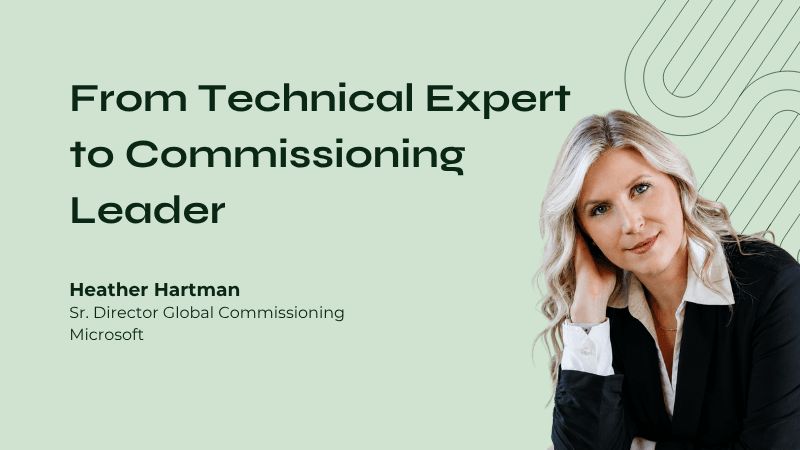
Heather Hartman's journey began in the electrical testing industry, where she worked in equipment repair, testing, and project support roles before progressing into technician positions, project management, and leadership roles supporting mission critical projects. Along the way, she helped develop commissioning programs, mentor future leaders, and build teams across some of the industry's fastest-growing environments.
To better understand how those careers develop, LVI Associates speaks with commissioning professionals across the industry, sharing lessons from people working at a senior level across mission-critical infrastructure, manufacturing, and construction.
In this edition, Alexander Karhunen speaks with Heather Hartman about what first drew her to commissioning, the lessons she learned transitioning from technical execution into leadership, and how she sees the future of the industry evolving.
The foundation of a commissioning leader
Alexander: What drew you to commissioning?
"I was looking to take a step in my career. My father is in the industry. He’s an electrical test technician, more of a specialist in troubleshooting. I got a job working at a circuit breaker company doing inventory and repairs on equipment."
"“At the same time, I was working for a private investigator, transcribing interviews and putting together inconsistent timelines. I thought I really wanted to go into the legal side, but I didn't have a great experience with that internship. I started to really like what I was learning about the electrical industry and testing. It's pass-fail criteria. It's very clear if it worked or did not work. Technology was starting to change, mission critical facilities were out there, everyone had UPSs and different switchgear, and I felt like I was learning a lot.
"I was really drawn to going to a different place every day and travelling. At the end of the day, I was delivering a better quality product for an end customer, so it made me feel good. I just loved the work. I looked at design engineering, but I don't like being behind a computer and sitting in an office all the time. I tried operations for a short minute to support a data center because I thought it would offer more stability and a standard schedule with shift work, but I didn't feel like it was challenging enough. When I was a data centre operator, I found myself wanting to be where the team was doing maintenance and asking everyone more questions. I realised I wanted to get back into that world again."
Alexander: How did your technical background shape your leadership style?
"I helped a smaller company open a Washington branch. They were based in Oregon and supported around 200 customers with maintenance and system upgrades. I got a lot of experience managing the whole end-to-end process and working with different technicians when something went wrong, troubleshooting issues and working with manufacturers to figure out what was happening. It was a lot of leadership without being a direct manager and a lot of supporting customers"
"When I moved into AWS, it became more direct technical support for projects, but commissioning naturally puts you in a position where you're influencing people. If you're really strong in commissioning, you're able to influence projects, keep things organised, make sure people are focusing on the right things and help them understand what needs to be addressed so the project can move forward. You're doing a lot of teaching."
Alexander: What was the hardest part of moving from technical expert to manager?
"I think the hardest part for me was the transition from individual contributor to manager and learning that I didn't have to be the expert on everything anymore. If you're the person in the field, I felt like I needed to have the answer. I always wanted to make sure that when I gave an answer, it was right, accurate and clear, so I'd do lots of research and make sure I knew I was right.
“Moving into management, there's more focus on training people, teaching them how to find their own information, supporting them and developing them, instead of always providing the answer yourself. That mental shift was difficult because I really did like figuring things out and fixing them. Now I've learned to do that through other people. It's actually more rewarding because I see them growing, putting all the pieces together and moving up in their careers instead of me taking all of that on."
Building high-performing teams
Alexander: How do you build high-performing commissioning teams?
"I like to bring people on at different levels, with different levels of experience and different types of exposure. I've actually reached out to a lot of people who hadn't even thought about the commissioning industry and encouraged them to look into it. I work on connecting transferable skills and bringing in different perspectives and experience levels.
“Yes, the Navy Nuclear Power Program is fantastic, but you don't need a whole team made up of the exact same people. You want different perspectives because the industry is getting bigger, everybody wants to go faster, and you need people who look at things through a different lens to come up with better solutions. A lot of people don't stay in commissioning because of the long hours, as everything gets compressed at the end. I spend a lot of time thinking about what I can change or improve to create a better work-life balance for people who want to stay in the industry. How can we get more people interested in joining commissioning and building long-term careers in it?"
Alexander: What mindset helped drive your career progression?
Throughout the interview, Heather repeatedly returns to accountability, ownership, and consistency.
“There are certain non-negotiables. You need to understand the specifications, the requirements, the expectations and the end result on every project, and really hold the line so people trust the product you're turning over. They trust that if I was the one testing it, it was done right.
“I'm very data driven. We need the data to prove that something passed or failed, and we need clear evidence of what the result should be. Removing ambiguity is a big part of being successful because there shouldn't be any question about how something should be responding or operating. One thing I'm really proud of in my career is knowing what I needed to do, taking full ownership and accountability for it, and building trust with other teams. As I've moved into management, helping others develop that same sense of ownership has become really important.”
Alexander: Were there any pivotal moments that shaped your career?
Not every important career moment comes from success. For Heather, one of the biggest lessons came after being turned down for an opportunity she wanted:
"I raised my hand for a global role and was told no.I took it really hard because I'd been there a long time and I thought I was ready for it. But instead of taking that as rejection, I said, 'What do I need to do? What do I need to demonstrate to be ready? Actually mapping out for myself how to get there instead of just applying for something and not getting it."
“Then when the Americas position came open, they didn't really interview me for it. It was just, 'Okay, yeah, this is yours. You're the person we need in that role. I think that aspect of not taking defeat personally and instead figuring out what needed to change was one of the most important things for my career."
Alexander: How did being a younger woman in commissioning shape your experience?
As Heather progressed through the commissioning industry, she was often aware that she did not fit the traditional profile many people expected to see in the field. Rather than allowing that to limit her, she used it as motivation.
I think not fitting the mould made me want to be more successful. I wanted to prove people wrong. I don't think anyone should have to go through things the hard way, be discriminated against or experience some of the situations that I've had. That's why I work to remove those barriers for other people, create training and make people feel supported. I think not fitting the mould made me want to be more successful. I wanted to prove people wrong. I don't think anyone should have to go through things the hard way, be discriminated against or experience some of the situations that I've had. That's why I work to remove those barriers for other people, create training and make people feel supported.
For Heather, the experience reinforced the importance of creating clearer pathways for others. That means helping people focus on tangible skills, confidence, and evidence of capability rather than comparing themselves to who has traditionally held leadership roles in the industry."
"Don't look around the room and not feel like you fit in. Look at the concrete things that mean you belong here. You can read a script. You can write a script for how to test something. You know how to troubleshoot. You understand which documents to get."
That perspective has shaped how she now develops teams, mentors others, and supports people who may not immediately see themselves represented in commissioning leadership.
Advice for the next commissioning generation
Alexander: What advice would you give to someone who doesn't see themselves represented in the industry?
"Speak up and don't be scared to talk. If you're going to talk, say it loud enough that people hear you. If you have something to say, say it, but make sure that you can back that up."
“When I was coming up through the industry, there was an amount of time you had to be in a role before you could get promoted. There was an expected tenure before you could be a manager.Those things don't exist anymore.Don't think, 'I've only been here two years. That means I'm not ready yet. Look at your skills. Look at the data. Look at what you've accomplished. Trust yourself more and don't assume someone else belongs in the room more than you do."
Alexander: How important are mentorship and sponsorship?
Throughout her career, Heather benefited from mentors, but she also learned the importance of actively seeking support rather than waiting for it:
"When I first started at AWS, they put me in a very rural area where they were building. I didn't know anyone else.The operations team wasn't very fond of the commissioning department. They didn't even give me a badge into the building."I had to go search out people to try to understand how to navigate."
“I needed to learn more about the mechanical and controls side of commissioning, and as soon as I found the smartest controls person that was there, I asked if I could spend five hours a week with them going through sequence of operations."
“I don't think everyone should have to fight for themselves. I think that's hard to sustain, and then people end up leaving the industry.People still must put in the hard work, but it shouldn't have to be that hard."
"I also think sponsorship is a big thing. AWS had a sponsorship program where a senior leader would meet with you regularly, understand what you were doing, and advocate for you in rooms you weren't in. That helped a lot in giving me confidence to move into some of those higher-level roles."
Where commissioning is heading next
Alexander: Where is commissioning heading next?
"I think there's going to be a lot of push to move more testing to factory levels and less on site. Commissioning is so data-driven and very pass-fail criteria, so sometimes it's hard for us to trust automation. But that's where we're going. Testing is going to be able to be programmed. We'll be able to write software so that systems run themselves through the paces and spit out the data. The need for commissioning engineers is so large in the industry, and there's a lot of very green people coming in. We need to find ways to automate, reduce risk, and go faster without compromising quality."
“I think we'll also see more people with software and programming backgrounds entering commissioning because those skill sets are going to become increasingly valuable."
Explore opportunities in commissioning
The commissioning industry continues to evolve as data center, mission critical, and advanced manufacturing projects grow in size and complexity. As Heather highlights throughout this conversation, the industry needs professionals who can combine technical expertise with strong communication, leadership, and problem-solving skills.
At LVI Associates, we work with commissioning engineers, commissioning managers, QA/QC professionals, and project leaders across North America. Through our conversations with professionals throughout the market, we gain firsthand insight into the skills employers are looking for, the challenges teams are facing, and the opportunities shaping the future of commissioning.
Whether you're looking to gain exposure to larger projects, move into a leadership role, transition into the data center sector, or expand your technical expertise, we would welcome a confidential conversation about your career goals and the opportunities available in today's market.
For organizations looking to strengthen their commissioning teams, we partner with contractors, consulting firms, owners, and mission critical operators to identify professionals capable of supporting complex projects while maintaining high standards of quality and execution.
To learn more about current opportunities in commissioning submit your resume here, or to discuss your hiring needs, connect with the LVI Associates team today.
We're always looking for commissioning and mission critical professionals to feature in Behind the Checklist. If you'd like to share your expertise and career journey, click here to take part.