October 20267 min read
Behind the Checklist: Felton Gwaltney II on Leading Teams and Raising Commissioning Standards
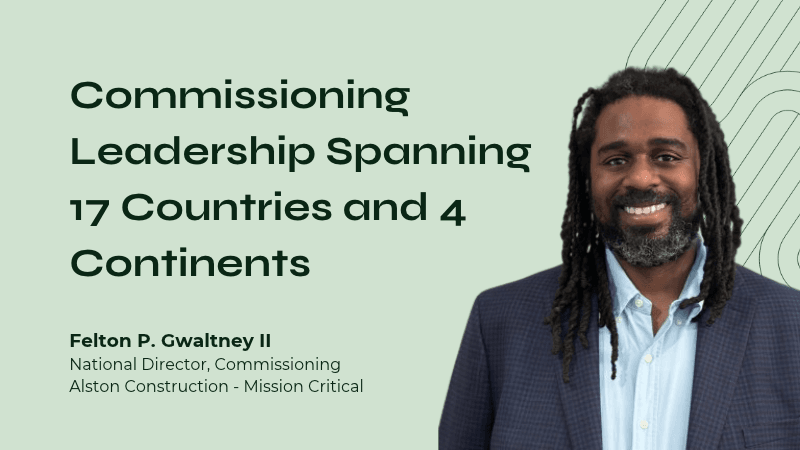
From maintaining military aircraft in the U.S. Navy to leading commissioning programs across the U.S., Felton Gwaltney II has built a career grounded in technical expertise, problem-solving, and critical infrastructure. With more than two decades of experience spanning 17 countries and four continents, his career reflects a deep understanding of how complex systems operate and what it takes to deliver them successfully.
Now National Director of Commissioning at Alston Construction, Felton draws on his experience in electrical engineering, field service, data center operations, and project delivery to develop commissioning standards and support teams across multiple projects. His move into commissioning marked a shift toward work that aligned more closely with his technical strengths, where identifying issues and improving system performance became central to his role.
In the latest instalment of Behind the Checklist, LVI Associates' Alexander Karhunen speaks with Felton about the experiences that shaped his career, his approach to developing commissioning professionals, and the challenges of maintaining quality as demand for data center infrastructure accelerates.
Building a career on technical experience
Alexander: How did your early career in electrical engineering and critical systems lead you toward commissioning?
Felton began his career as an aviation electrician in the U.S. Navy, developing the electrical knowledge and troubleshooting skills that would support his later work in critical infrastructure.
Following his military service, he moved into field engineering with Russelectric, working on electrical power systems across data centers, hospitals, and other facilities where reliability was essential. He later took on roles in data center operations and critical systems management, gaining a different perspective on how facilities are maintained and managed.
"I feel like I've built something from every stop I've made, good or bad. My technical foundation came from the Navy. I learned about electricity and the fundamentals and theory of electricity in the Navy."
"I learned how to apply it in practice and how to troubleshoot, being in the field. I was fortunate when I first got into this industry. I worked with a lot of guys and ladies that had been around for a long time and showed me the ropes."
As his career progressed, Felton recognized that commissioning offered the opportunity to apply that experience more directly to testing equipment, identifying issues, and improving system reliability.
"By the time I got to that point, I was sound technically. I knew the equipment. All I had to do was test the equipment and identify issues. I could do that all day long."
The lessons that shape effective leadership
Alexander: What habits did you learn from your experience in mission-critical facilities, and how did they shape your approach to leadership and problem-solving?
Working in mission-critical environments taught Felton the importance of attention to detail and maintaining composure under pressure. As a field service engineer, he often responded to equipment failures when facilities were already facing significant disruption.
"The first thing is attention to detail, that everything matters. You've got to pay attention to everything because the smallest detail can make things go sideways."
"The second is to be calm under pressure. Being a field service engineer for Russelectric, when you walk in, usually you get an emergency call in the middle of the night. You're walking into somebody's worst-case scenario."
His experiences in management also influenced how he communicates with colleagues and approaches decisions. Having worked in environments where employees had limited opportunities to challenge decisions, Felton became conscious of the importance of explaining expectations and listening to his teams.
"If I'm telling my guys to do something and they don't agree with it, it's my job to make them understand why I feel that way and why I feel the need to go in that direction."
For Felton, effective leadership depends on creating an environment where people understand the reasoning behind decisions and feel comfortable contributing their own expertise.
Developing the next generation of commissioning professionals
Alexander: What responsibility do experienced commissioning leaders have in addressing the industry's skills gap?
The rapid expansion of data center construction has created growing demand for commissioning professionals. While opportunities have increased, Felton believes the industry faces a particular challenge in developing people with the practical experience needed to support increasingly complex projects.
"There's definitely a talent gap. I wouldn't say talent, but an experience gap. When I first got into the data center industry, there was one, maybe two big projects a year. Now there's a new one every other day."
For Felton, addressing this gap requires experienced professionals to share their technical knowledge and invest in developing those entering the industry. He believes the strongest professionals develop through a combination of formal training, field experience, and interpersonal skills.
"It takes people like me and senior-level people that have been in the industry for a while to take that knowledge that we have and give it to the people coming behind us."
Equally important is hands-on exposure. Felton believes young engineers need opportunities to spend time in the field learning how systems operate, how equipment is tested, and what successful commissioning looks like in practice. Understanding equipment is important, but so is knowing how to communicate with clients, manage subcontractors, and respond to challenges on-site.
"You have to go out in the field and train on what to look for when you inspect equipment, what to look for when you're testing equipment."
"It's also the soft skills on how to deal with clients, how to deal with subs when they don't perform or when they don't give you the responses and answers that you were expecting."
Having worked for manufacturers, contractors, owners, and service organizations throughout his career, Felton believes that understanding different perspectives is one of the most valuable skills a commissioning professional can develop. While accountability is critical, successful project delivery often depends on balancing expectations, maintaining relationships, and keeping the broader project goals in focus.
"When I talk to a subcontractor, like an electrical sub or equipment vendor, I understand what they're trying to do because I've been in their shoes. I try to be as accommodating as possible, but at the same time hold them accountable to the bigger picture and the milestones and dates that we're all committed to."
Maintaining commissioning quality as the industry grows
Alexander: How has the commissioning industry changed, and what concerns you most about its direction?
Having worked across international projects and different areas of critical infrastructure, Felton has seen significant changes in the technical requirements of commissioning.
"When I first got into the industry, the commissioning professionals were the subject matter experts. That's not necessarily the case anymore. I've worked with commissioning engineers who have never had the opportunity to work directly with the equipment they're testing. That's largely a reflection of how quickly the industry has grown and how high the demand has become."
He notes that while data center electrical systems have become larger but relatively less complex, mechanical systems have become increasingly sophisticated, changing the expertise required within commissioning teams.
"Electrically, data centers are simpler. They're bigger, but they're simpler. The electrical systems aren't as complex as they were 10 years ago. On the flip side, the mechanical systems are way more complex."
Alongside these technical changes, Felton is concerned about the pressure to accelerate project delivery as investment in AI and data center infrastructure increases.
"Everybody's trying to get to market as fast as possible. It's going to lead to corners being cut and not doing due diligence like you would a couple of years ago."
He believes greater consistency in industry standards could help address these pressures, although establishing common expectations remains challenging in a sector where project requirements and operating practices can vary considerably.
Creating consistency and clear career progression
Alexander: What achievements are you most proud of, and how have they influenced your approach to commissioning leadership?
One of Felton's priorities has been developing structured commissioning programs that establish clear standards for project delivery and professional development.
During his time at Skanska, he helped implement a commissioning program and develop a defined career path. He has since applied a similar approach at Alston Construction, introducing a commissioning manual and establishing expectations for different roles.
"At Alston, I wrote job descriptions and a career path from commissioning engineer all the way to director of commissioning, with competencies and everything that can be evaluated by anyone. There's clear criteria for each position."
These structures help define the skills and experience required for career advancement, giving commissioning professionals a clearer understanding of how they can progress.
Felton also recognizes that consistency across projects does not mean every team must approach its work in exactly the same way.
"The foundation of that is our commissioning manual. That's a living document. That's the bare minimum for all our sites. That's the starting point for every job."
"There's always another way to do something. Just because they might do something differently than I would doesn't necessarily make it wrong."
Moving from technical expertise to national leadership
Alexander: What has been the biggest adjustment in moving from delivering projects to leading commissioning teams nationally?
Stepping into national leadership has required Felton to move away from being directly responsible for solving every technical issue and toward supporting the people delivering projects.
"One adjustment is that I don't have to put out every fire. My job is to know what's going on, but to trust my guys to handle it and to come to me when they need me."
"My number one job is to remove obstacles from my team, to make sure that they have what they need to succeed and to remove anything that's in the way of that success."
While his technical experience remains valuable, Felton acknowledges that the transition has involved adjusting how he contributes to project success.
"I was able to advance to this role by being really good technically and being the go-to guy technically, and that's not really my role anymore."
His focus is now to provide teams with the resources, guidance, and autonomy needed to deliver projects while maintaining shared expectations across the organization.
Advice for professionals entering commissioning
Alexander: For someone looking to move into commissioning without a traditional background, what skills matter most?
Felton believes professionals from electrical, mechanical, and controls backgrounds can build successful careers in commissioning, provided they have a strong technical foundation and the ability to assess systems carefully.
"It's really two things. Everything else is negotiable. One, it's a strong level of attention to detail. And two is some type of technical background in electrical, mechanical, or controls."
For Felton, those foundations matter more than following a particular career path. With the right technical understanding and practical training, professionals can develop the wider skills required to advance.
"Everything else can be taught."
A career built on consistency
From electrical field engineering to national commissioning leadership, Felton's career reflects the value of practical experience, continued development, and learning from different working environments.
His focus on technical standards, professional development, and supporting teams offers a perspective on the responsibilities facing commissioning leaders as the industry expands.
When asked to identify the principle that has guided his career, Felton's answer was simple.
"Consistency. I feel like I've gone my whole career just trying to be consistent across the board in everything I do, from when I was a technician doing field work, to running commissioning at the project level, to now running a commissioning program."
If you're ready for your next opportunity in commissioning, QA/QC, or mission-critical project delivery, register your resume with LVI Associates' specialist consultants to discuss your career goals.
We're always looking for commissioning and mission-critical professionals to feature in Behind the Checklist. If you'd like to share your expertise, get in touch with LVI Associates.