February 2026Erin Stanton3 min read
Data center commissioning salary ranges by US state

Data center commissioning salary growth in the USA continues to outpace many other engineering disciplines. What we are seeing in the market is sustained demand colliding with a limited pool of experienced commissioning professionals. This has pushed salaries higher across most major data center locations, but pay alone is no longer enough to secure talent.
Nationally, data center commissioning engineers earn around USD 145,000 to 150,000 per year, depending on experience and project scope. This remains well above general commissioning roles, which typically average closer to USD 110,000 to 120,000. The premium reflects risk, responsibility and the commercial impact of commissioning delays.
How state location affects data center commissioning salary
Virginia and California sit in the same rough data center commissioning salary range, and state location continues to influence pay more than job title alone.
Why? Because salary levels closely track data center build concentration and cost of living. States with dense hyperscale, colocation and modular activity show the strongest commissioning salary growth, while secondary markets continue to lag.
Virginia easily leads the market, with Northern Virginia the largest data center hub globally, and commissioning salaries consistently exceeding the national average. Senior engineers and commissioning leads are securing USD 150,000 to 180,000, often with sign on bonuses or retention incentives tied to project milestones.
California also sits at the top end of the market, driven by Silicon Valley and large enterprise campuses. Salaries commonly fall between USD 150,000 and 180,000. Growth has slowed slightly as companies rebalance spend and redirect new builds into lower cost states.
Washington also remains competitive, supported by steady hyperscale demand and limited local supply, which continues to put upward pressure on pay.
Texas shows one of the fastest growth curves, with Dallas and Austin attracting major projects, and salaries typically ranging from USD 130,000 to 160,000. Employers increasingly lean on cost of living and lifestyle advantages to compete with coastal markets.
States with smaller data center footprints tend to trail the national average. Even so, experienced commissioning professionals still command a clear premium compared to other engineering roles.
Data center commissioning salary guide map
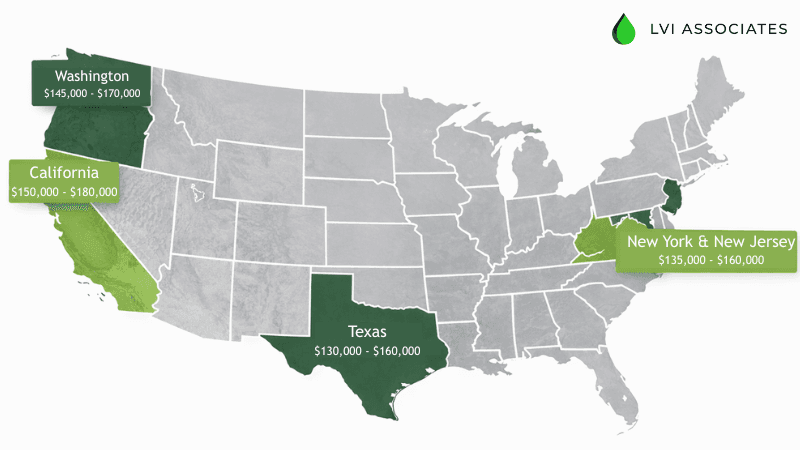
Hiring and want to see commissioning salary ranges across data centers and other critical infrastructure by state?
How data center type changes salary
Data center commissioning salary growth varies by facility type, even within the same state. Our latest data center salary guide breaks down how pay shifts by project scale, risk and delivery pressure.
- Hyperscale data centers typically offer above average pay. These projects carry scale risk, tight delivery windows and zero tolerance for failure. Hyperscalers pay a premium for engineers with integrated systems testing and large campus experience.
- Colocation facilities sit just below hyperscale. Pay generally aligns with state averages, but volume matters. Engineers who can move quickly between builds and manage frequent client sign off cycles remain in high demand.
- Enterprise data centers usually pay less. Sites are smaller and slower paced, with lower average compensation than hyperscale environments. Companies delivering complex upgrades or operating live environments still compete aggressively for senior commissioning talent.
- Edge data centers vary widely. Individual sites tend to pay less, but multi-site responsibility and travel can lift total compensation.
What is driving data center commissioning salary growth
Data center commissioning salary growth remains strong due to a small number of structural pressures.
Build schedules continue to compress, placing commissioning directly on the revenue critical path. Delays now impact handover, capacity delivery and cash flow, pushing companies to pay more to reduce late-stage risk. Rising system complexity has further narrowed the talent pool, particularly for engineers who can lead integrated systems testing across electrical, mechanical and controls scopes. Mobility also remains a premium, as new data center regions scale faster than local workforces.
As Erin Stanton, Consultant at LVI Associates, explains
Commissioning is no longer a final technical sign off, it sits at the center of delivery risk and revenue protection. Companies that still treat commissioning as an end stage function struggle to hire and retain experienced engineers, and the employers winning talent are the ones that involve commissioning early, give it authority, and recognize its commercial impact, not just its technical role.
This shift in how commissioning is valued continues to drive salary growth and separate successful hiring strategies from reactive ones.
Why companies struggle to find commissioning talent
Despite sustained data center commissioning salary growth, companies continue to struggle to hire. The core issue is supply. Experienced commissioning engineers are scarce and slow to replace because true commissioning capability is built over years on live projects, not in design offices or short training cycles. Many candidates have partial exposure but lack -to-end commissioning ownership, which immediately limits the available talent pool.
At the same time, senior engineers are steadily exiting -based roles. As commissioning professionals gain experience, many move into management, consulting or independent contracting, where autonomy is higher and site pressure is lower. Project intensity also plays a role. Commissioning sits at the most demanding phase of delivery, with long hours, travel and high accountability at handover. Even strong compensation does not fully offset this, particularly for engineers later in their careers.
Rapid regional expansion has added further strain. New data center markets are scaling faster than local workforce development, forcing companies to compete nationally for the same engineers. This drives longer hiring cycles, frequent offers and rising salaries without increasing supply. Where roles are poorly defined or commissioning is brought in late, reputation spreads quickly, making it harder for some employers to attract talent regardless of pay.
How companies are winning talent on their projects
What we are seeing in the market is a clear split between companies that struggle to hire commissioning talent and those that consistently secure it, but the difference is rarely salary alone. The strongest employers engage commissioning engineers early, often well before construction peaks, and treat commissioning as part of delivery planning rather than a late-stage fix. This early involvement signals intent and reduces the risk engineers associate with last minute project pressure.
Clarity is another differentiator. Engineers respond to defined scopes, realistic schedules and clear decision authority during commissioning. Where roles are vague or responsibility is high, but authority is limited, attrition follows quickly. Companies that succeed are explicit about expectations and empower commissioning teams to make decisions during testing and handover. This builds trust and reduces burnout.
Progression and workload management also matter. Employers that map engineers from site roles into lead or programme level positions retain talent for longer. Rotation models, predictable travel patterns and protected time off between projects now influence hiring decisions as much as base salary. Above all, companies winning talent treat commissioning as a strategic function with real influence, not a checkbox at the end of the build.
Hiring outlook for data center commissioning in the USA
Data center commissioning salary growth in the USA will continue, but differentiation will matter more than pay alone. Hyperscale, colocation and modular builds in Virginia, Texas and Arizona will remain the most competitive markets as new capacity overlaps with retrofit and upgrade programmes.
What is changing is how commissioning roles are assessed. Experienced engineers are prioritizing delivery realism, authority on site and long-term progression alongside compensation. Companies that continue to treat commissioning as a late-stage or transactional function will struggle to hire, even with strong salary offers.
LVI Associates is observing employers succeed when they engage early, define commissioning scope clearly and align roles with realistic project cadence. Those conversations are happening earlier in the project timline, often 6 to 12 months before peak demand.
If you are planning to hire commissioning engineers or authorities, request a call back. Early market insight reduces hiring risk and improves outcomes in a tightening talent market.