July 2026Bryan Pollock6 min read
Floating Data Centers at Sea
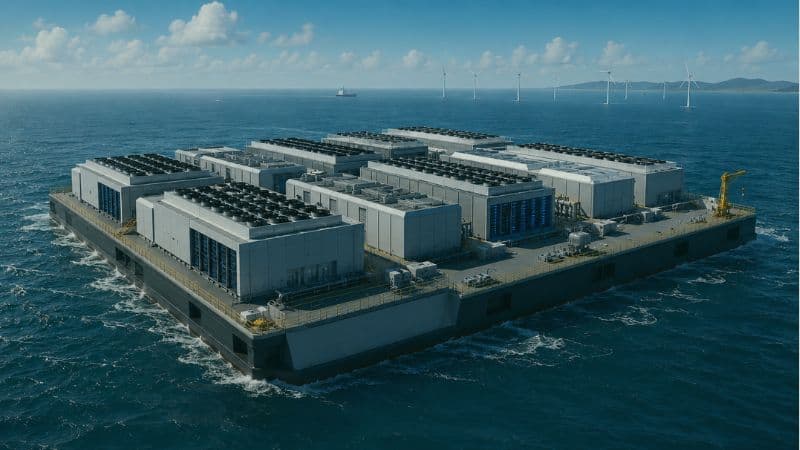
Floating data centers are gaining attention as the data center market runs into hard limits on land, power, cooling, water use, and planning approval. As AI, cloud services, streaming, financial platforms, healthcare systems, and industrial tools demand more compute capacity, operators are being pushed to consider new infrastructure models.
A floating data center places compute infrastructure on a barge, vessel, pontoon, or marine platform. It can sit close to coastal demand, use seawater as part of its cooling strategy, and reduce pressure on scarce land. In some cases, it may also connect to port infrastructure or offshore energy.
The idea sounds simple: place servers near the sea, support cooling with seawater, and avoid land shortages. The reality is more complex. Saltwater damages infrastructure, storms increase operational risk, maritime regulation can slow projects, fiber and power links still need to reach the site, and the environmental impact does not disappear because the facility moves offshore.
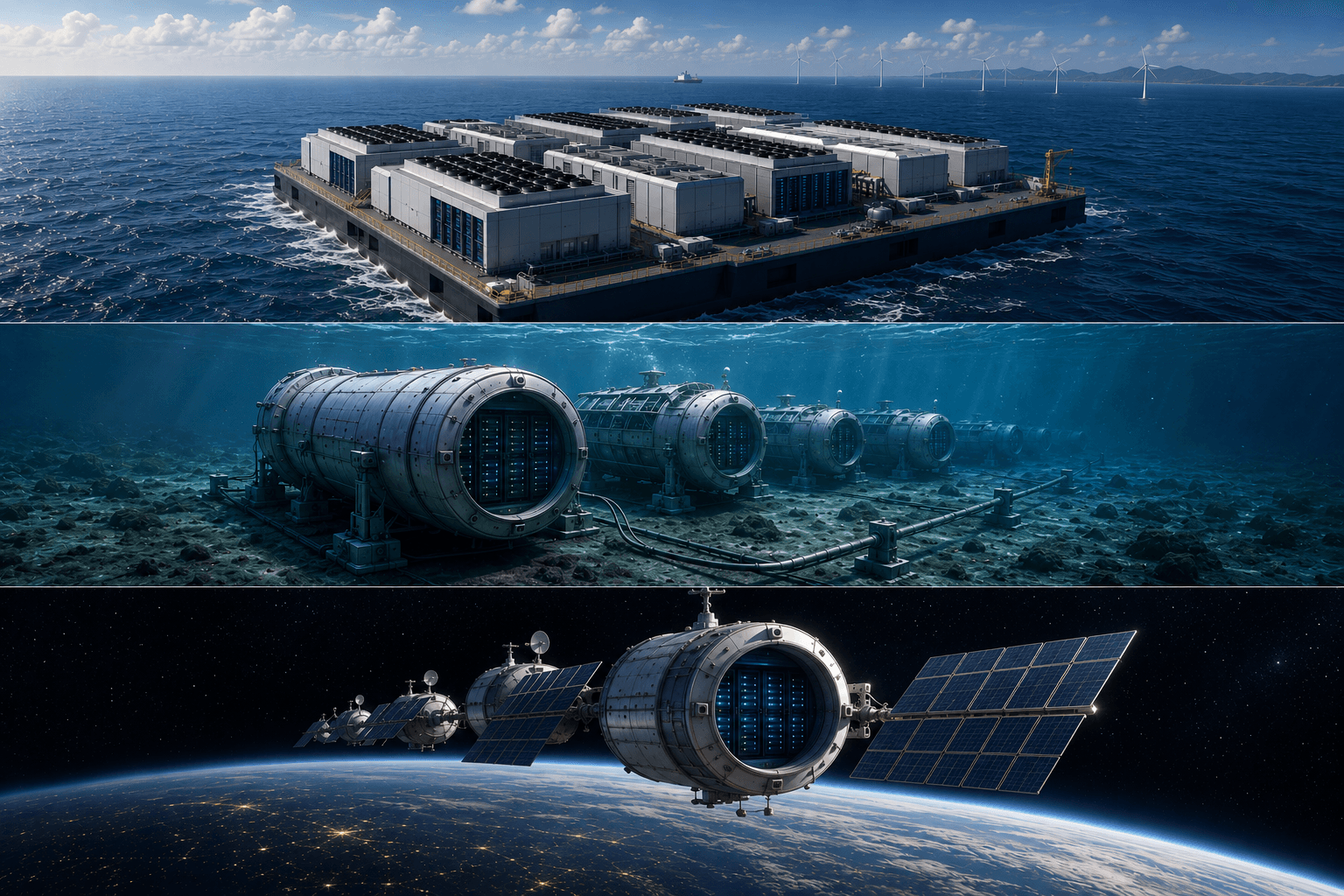
This sits alongside wider industry debate around alternative data center models, including underwater data centers and data centers in space.
Why floating data centers are being discussed
Most data center projects face the same pressures: power, cooling, land, water, regulation, and labor. Floating data centers are attracting interest because they could use seawater-supported cooling, sit close to coastal demand, and reduce pressure on scarce urban land.
In most designs, seawater would support a closed-loop cooling process rather than running through the servers directly. This could reduce freshwater use and reliance on traditional cooling systems.
Nautilus Data Technologies’ Stockton 1 facility in California shows that a nearshore floating data center can be built and operated. The facility offers 6.5MW of critical IT load across four secure vaults, according to Nautilus. However, wider commercial adoption remains limited, and most floating data center concepts are still at pilot, platform development, or early commercial stages.
Panthalassa is pushing a more ambitious version of the concept, with ocean platforms designed to power AI data centers using wave energy and seawater cooling. Its Ocean-3 platform has brought fresh attention to ocean-powered compute, but the model still needs to prove it can address corrosion, storm exposure, maintenance, connectivity, insurance, and environmental approval at scale.
The main problems with floating data centers
Floating data centers may reduce pressure on land and freshwater, but they shift risk into a marine environment. That changes the engineering, maintenance, regulatory, and security profile of a project.
Saltwater corrosion
Saltwater speeds up corrosion and increases wear on platforms, cooling systems, pipework, moorings, cable routes, pumps, filters, and access structures. Even if the servers sit inside sealed, climate-controlled spaces, the wider facility still needs marine-grade materials, protective coatings, corrosion monitoring, planned replacement cycles, and specialist maintenance teams. For mission-critical infrastructure, this matters because marine conditions can delay repairs and affect uptime.
Storms, waves, and flood risk
A floating data center must withstand storms, high winds, waves, flood events, and sea-level pressure. Sheltered ports reduce some exposure, but they do not remove the need for strong mooring systems, safe access routes, emergency planning, marine insurance, and resilient power and fiber connections. Unlike a fixed land-based site, a floating platform adds movement, marine loading, vessel activity, and port safety rules.
Power supply
Cooling may improve at sea, but compute still needs large, stable, high-quality power. A floating facility could use shore power, nearby generation, offshore wind, marine energy, onboard generation, or a hybrid system with backup power. Each option adds cost. Shore power still depends on grid capacity, offshore renewables need balancing or storage, and fossil-fuel backup weakens the sustainability case. For AI workloads, this becomes sharper because dense GPU clusters need reliable power and cooling at the same time.
Fiber and connectivity
A floating data center needs high-capacity fiber links to land. Nearshore sites benefit from shorter cable runs, but they may also face port restrictions, shipping lane issues, dredging risk, and local objections. For low-latency workloads, such as financial services, gaming, real-time AI applications, and cloud services, network design becomes central to the business case.
Regulation, environment, and security
Approvals can involve port authorities, environmental regulators, coastal planning bodies, telecoms regulators, grid operators, maritime safety bodies, insurers, and local government. Legal status may also be unclear: vessel, building, utility asset, telecoms site, or critical infrastructure.
Environmental scrutiny is just as important. Key concerns include warm water discharge, seawater intake systems, impact on marine life, anti-fouling chemicals, pump and vessel noise, light pollution, anchoring, seabed disturbance, and decommissioning.
Security also changes at sea. Operators may need marine surveillance, restricted zones, vessel monitoring, access control, port police coordination, and cable protection to manage risks such as vessel collision, sabotage, unauthorized boarding, drone surveillance, cable interference, and port disruption.
Problem comparison: Floating, underwater, and space data centers
| Problem area | Floating data centers at sea | Underwater data centers | Data centers in space |
| Cooling | Strong case for seawater-supported cooling, but corrosion, biofouling, intake design, and warm water discharge matter. | Natural seawater cooling is the main strength, but repair access is harder. | Space has solar power, but cooling is difficult because heat must be radiated away. |
| Maintenance | Engineers can board the platform, but weather and marine safety can delay work. | Hard to access after deployment. Better for sealed, standardized modules. | Repairs are expensive and often impractical. |
| Power | Still needs major power supply. Shore power, offshore renewables, and backup systems all add cost. | Also needs power and subsea cabling. | Solar power is attractive, but launch cost, batteries, radiator mass, and communications limit the case. |
| Commercial readiness | Most realistic of the three. Nautilus has shown nearshore operation, while Panthalassa is testing a more ambitious model. | Proven in trials, but not scaled commercially. | Early-stage for mainstream cloud workloads. |
How floating data centers compare with other models
Underwater data centers place sealed server modules below the surface, often on the seabed. Microsoft’s Project Natick showed that subsea data centers could be tested in real conditions, but access remains difficult. Microsoft has since confirmed that Project Natick is no longer active, which supports the point that technical success does not always translate into commercial scale.
Data centers in space sit at the other end of the debate. Orbit offers solar energy and no land constraint, but space-based facilities face harder barriers than floating platforms. Launch costs remain high, hardware needs radiation protection, cooling is difficult, and data transmission back to Earth can become a bottleneck. These comparisons show why floating data centers are the most realistic near-term alternative: less radical than orbital infrastructure and more accessible than sealed subsea modules.
What this means for data center development on earth
Most data center growth still needs to happen on Earth, and every project depends on specialist talent across power, site selection, design, construction, commissioning, operations, and sustainability.
According to Bryan Pollock, Senior Vice President, Data Centers & Mission Critical at LVI Associates:
Floating data centers are an interesting response to the pressure we’re seeing across the market, but they don’t remove the fundamentals of data center delivery. You still need power, cooling, fiber, permitting, commissioning, and experienced project leadership. The difference is that a marine environment adds another layer of complexity. For developers, the question is not only can this be built, but can it be delivered safely, reliably, and commercially at scale?
That is the core issue. Floating data centers may sit offshore, but they still need the same delivery expertise as land-based facilities, with added pressure around corrosion, weather exposure, port access, environmental approval, and marine maintenance.
At LVI Associates, we support data center developments across the full project lifecycle. Our data center recruitment teams work with developers, contractors, operators, engineering firms, investors, and infrastructure businesses to connect them with the specialists needed to deliver critical projects, from site selection and design through construction, data center commissioning specialists, operations, and maintenance.
Where floating data centers could make sense
Floating data centers will not suit every market. They make the strongest case where several conditions overlap: strong coastal data demand, limited land availability, port infrastructure, access to low-carbon power, and clear permitting routes.
Major coastal cities often have strong demand for cloud, AI, finance, telecoms, and enterprise infrastructure. A floating site could support low-latency services without needing a large city land parcel. Ports are also natural candidates because they already manage vessels, security, heavy engineering, marine safety, and logistics.
But floating data centers are a weak fit where grid capacity is already constrained, coastal regulation is unclear, marine ecosystems are sensitive, storm risk is high, or skilled labor is scarce. A floating site with no power strategy is not innovation. It is a stranded asset risk.
The sustainability claim needs proof
Floating data centers are often framed as sustainable because they can reduce freshwater use and make better use of space. That may be true in some designs, but sustainability claims need evidence.
Operators should be expected to publish or verify power usage, cooling performance, water impact, marine discharge data, electricity carbon intensity, maintenance emissions, biodiversity monitoring, decommissioning plans, and backup power strategy. Without that data, the sustainability case is mostly marketing.
Building the teams behind the next generation of data centers
Floating data centers offer a credible near-term alternative for specific coastal markets, but the real challenge is not only technical. These projects need the right teams behind them from the earliest planning stages through to delivery, commissioning, and long-term operations.
Saltwater corrosion, storm exposure, fiber links, power supply, port regulation, environmental impact, security, and marine maintenance all affect the business case. Developers, investors, contractors, and operators will need people who understand data center delivery, as well as the extra pressure that comes with building in a marine environment.
At LVI Associates, we have extensive experience supporting data center developments across design, construction, commissioning, operations, and maintenance. Our teams work with developers, contractors, operators, engineering firms, investors, and infrastructure businesses to connect them with the specialists needed to deliver critical projects.
Floating data centers may become part of the future data center mix, but success will depend on more than the concept itself. The strongest projects will be built around clear power strategy, proven cooling design, environmental controls, regulatory planning, and the right technical leadership.
If you are planning a data center project or need support building the team to deliver one, request a call back from LVI Associates to discuss how we can help.