July 2026Alexander Karhunen7 mins read
Behind the Checklist: Communication Skills in Data Center Commissioning Featuring Alan Roche
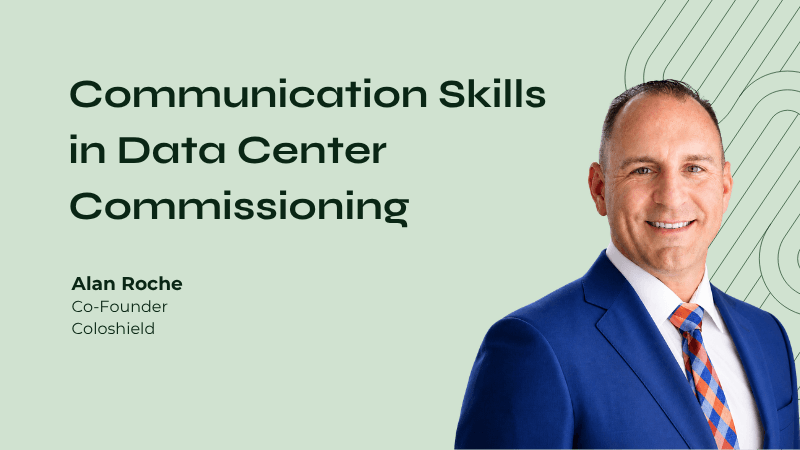
Data center commissioning is moving fast. Projects are becoming more complex, liquid cooling is moving into live delivery, and commissioning teams are being asked to make decisions with less time and less margin for error.
In this edition of LVI Associates’ Behind the Checklist series, Alexander Karhunen speaks with Alan, co-founder at ColoShield, about his path from Navy submarines to data center commissioning, the leadership lessons that shaped his career, and what the next generation of commissioning professionals should focus on.


ColoShield is a specialist commissioning and consulting firm focused on liquid-cooled AI data centers. The company brings together engineers, program directors, and construction managers with experience delivering liquid-cooled colocation data centers at production scale. Its work sits where commissioning, construction delivery, and liquid cooling readiness meet, helping project teams plan, test, and bring complex cooling systems online with fewer reactive decisions.
From submarines to data center commissioning
Alexander Karhunen: You started your career in the Navy before moving into commissioning. How did you first get into the space?
“I got out of the Navy and spent two years working in the shipyards. After a while, I knew I needed to get away from submarines and find something new. I did not want to keep doing the same thing. I reached out to Larry, who was starting a data center commissioning team, and I asked him, " What is that? I had no idea what commissioning meant in that context.”
Once he started in commissioning, the connection to his Navy experience became clear. Before a submarine goes to sea, teams work through detailed checks, energize equipment, run diagnostics, and confirm systems are ready. The setting changed, but the logic carried over.
Alexander Karhunen: Did you see parallels between the work you were doing in the Navy and the work you do now in commissioning?
“Commissioning comes from the naval idea of commissioning a ship before it goes to sea. Every time we took the submarine out, we worked through a checklist. Three days out, 48 hours out, 24 hours out, 12 hours out, six hours out, two hours out. You are energizing equipment, turning systems on, running diagnostic checks, and making sure everything is ready. That is essentially what we are doing in a data center. We are making sure the equipment works before it needs to perform.”
The same applied on the leadership side. In the shipyard, Alan had to coordinate multiple groups that did not report directly to him. On a construction site, the same challenge exists across general contractors, mechanical teams, electrical teams, vendors, and owners.
“Being in the shipyard prepared me more than anything. On a job site, you have the general contractor, mechanical teams, electrical teams, vendors, and 10 different companies that all need to work together. The shipyard was the same idea. My job was to figure out how to get those groups to help meet the goal.”
Why commissioning is a people business
Alexander Karhunen: For engineers who do not come from a Navy background, what advice would you give them to perform well in commissioning?
“In commissioning, you have to be a good culture fit first. Then you need the right leadership and communication skills. The resume comes after that. You can understand how commissioning works, but if you cannot communicate and you are not a good leader, you become a problem on the project.”
For Alan, the technical side can be taught. The bigger issue is whether someone can communicate clearly, lead in the field, and work well across different teams. As demand increases, our insight on data center commissioning salary growth highlights strong pay premiums in major US markets, driven by limited talent and rising demand.
“I have met plenty of good engineers who are good people, but they do not communicate well. That makes it hard for them to be in a client-facing or leadership role. The technical side can be taught. You will learn as you go. But you have to work at the people part of it.”
That people-first view shows up in how he handles pressure too. When projects become stressful, the answer is not to escalate. It is to slow the situation down, ask better questions, and keep the team focused.
Alexander Karhunen: Across the companies you have worked with, what recurring mistake have you seen?
“No matter what you are doing, building a submarine, building a data center, or working in another industry, the problems usually come back to people. There are plenty of smart people out there, and there are always technical resources. You do not need to be the smartest person in the room. You need to ask the smartest questions.”
Early in his commissioning career, asking questions became one of Alan’s strongest habits.
Alexander Karhunen: What habits helped you progress in your career?
“When I first got into commissioning, there were times where I did not know what I was looking at. So I asked a lot of questions. If I was testing a piece of gear with a vendor, I would say, teach me everything you know about this. Teach me something only you know. What have you seen that I should watch out for?”
Those conversations helped him learn faster and build stronger relationships with vendors and specialists.
“People get excited when they can share what they know. When you ask those questions, you learn something, but you also build a relationship. It shows that you care about the work and respect what they know.”
Liquid cooling, planning, and the next phase of commissioning
Alexander Karhunen: What excites you about building something at this stage of your career, especially in a market like liquid cooling?
“Data centers are being built so fast right now. It takes a certain kind of person to see a day ahead, two days ahead, or a week ahead and recognize what is going to become a problem. Then you have to put the right steps in place before it becomes an issue.”
That forward-looking approach sits at the center of ColoShield’s work. The company focuses on liquid-cooled AI data centers, where higher-density environments, tighter schedules, and more complex cooling systems are forcing project teams to rethink traditional commissioning models. Their insight on liquid cooling commissioning expands on why commissioning is often the harder part of deploying these systems.
Our analysis of data center site selection also points to power deliverability, cooling feasibility, water availability, regulation, and workforce capacity as major constraints for 2026 projects.
“The way things are commissioned now is not the way they were commissioned even one or two years ago. People have to think differently. The idea of, this is how we have always done it, does not apply anymore. That mindset will hold you back.”
Alan does not see liquid cooling as a complete technical reset. The fundamentals still apply, but the sequencing, planning, and speed of decision-making are changing.
Alexander Karhunen: With the shift toward liquid cooling, are there gaps you are seeing in industry readiness?
“There is a big gap in planning. Everybody wants these systems now. They wanted them yesterday. But these systems are new, and they will only go well if they are planned well. Without that planning, you are almost guaranteeing that the project becomes reactive.”
Risk management is a major part of that shift. For Alan, the goal is not to cut corners. It is to understand where time and testing matter most. This also connects to wider delivery changes, with our insight on modular data center delivery outlining how AI capacity growth is driving faster deployment and repeatable build models.
“You have to understand what the client wants now, because it may not be the same thing they wanted two years ago. It is not about cutting corners. It is about knowing where the risk sits. If the risk is low, maybe you do not need to inspect or test something in the same way. If the risk is high, that is where your focus needs to be.”
Alexander Karhunen: Are there different skill sets becoming necessary as commissioning changes?
“Liquid cooling is not completely different. It is a different sequence in how you test. The same principles are there, fluid dynamics, electricity, pressure, temperature, and flow rate. You already verify those things in other systems. The difference is how fast the projects are moving.”
That speed requires commissioning professionals who can gather information, understand requirements, and communicate direction across multiple companies quickly.
“You do not always have a week to study the problem. You need to gather the information, understand the requirements, see the full picture, and turn that back to the team. You have to say, this is what needs to happen, I need you to do this, and I need you to do that. And many of those people work for different companies, not for you.”
Building something different
Alexander Karhunen: As you moved into the entrepreneurial side of your career, what was going through your mind?
“I was always asking myself, how do I prepare to have my boss’s job someday? Earlier in my career, someone left, and I got asked if I wanted to replace him or if they should hire someone else. I said I would figure it out and step up. That is what I did.”
That mindset carried through later career moves. When he felt he had reached a ceiling, he knew he needed a new challenge. Co-founding ColoShield gave him the opportunity to build in a market that is still developing, while applying lessons learned from the Navy, commissioning firms, owner-side roles, and large-scale project environments.
“I’m always looking for what’s next for my career and I wasn’t sure what that was a few months ago. Then this opportunity came up, and I saw it as the next thing. Now, as a co-founder and part owner, I do not have to think about what is next in the same way. Now the work is to build this company the way we believe it should be built.”
That also includes helping other people grow. Alan sees leadership as understanding what people want, even when their long-term path may take them somewhere else.
Alexander Karhunen: You have spoken about helping others succeed. What does that look like in practice?
“It starts with talking to people and understanding what they need and what they want. If someone wants to work for our company for the rest of their life, great. If they do not, that is fine too. I expect people to grow and move. But tell me what you want. Tell me if you feel like you have hit a ceiling. Tell me if you are thinking about what comes next.”
He believes companies can still support people honestly, even when their goals extend beyond one employer.
“If someone comes to work with us and says they want to be here for two years because they want to become a VP at a major data center company, great. We will help them do that. Come learn with us, build your skills, connect with the right people, and grow.”
Advice for early-career commissioning professionals
Alexander Karhunen: If you met someone younger who reminded you of yourself early in your career, what advice would you give them?
“Practice talking to people. Do not be afraid of it. My daughters are in Girl Scouts, and I make them go door to door selling cookies. I do not care about the cookies. I care about the personal engagement. They are learning how to approach someone, speak clearly, and build confidence.”
For Alan, that skill is becoming less common and more valuable. Technical knowledge matters, but commissioning careers often advance because someone can ask questions, build trust, and get people moving in the same direction.
“A lot of people are behind phones or screens now. They do not always know how to communicate face to face. But successful people in business are not always the people who were top of the class. It is often the people who are smart enough, have strong personal skills, build teams, and know how to relate to people.”
For an industry built on testing, documentation, and checklists, his message is clear. The technical work matters, but the strongest commissioning careers are built through communication, trust, and care for the outcome.
Building the teams behind commissioning
Alan’s perspective reflects a wider challenge across data center commissioning. Technical demands are rising, timelines are tightening, and liquid cooling is changing how projects are planned, tested, and delivered. ColoShield’s focus on liquid-cooled AI data centers speaks directly to that shift, where teams need field experience, planning discipline, and strong communication to bring new cooling infrastructure online at scale.
LVI Associates works with data center developers, operators, contractors, and investors to connect them with the specialist talent needed across mission-critical projects. This includes commissioning and quality assurance professionals, critical systems specialists, project managers, construction leaders, facility teams, and technical experts across power, cooling, and infrastructure.
For organizations building or expanding data center teams, LVI Associates provides access to professionals who understand the pace, risk, and technical demands of modern project delivery. Out insight on data center recruitment timelines also shows why hiring conversations often need to start well before peak delivery demand.
To discuss hiring needs or explore new opportunities in commissioning and mission-critical infrastructure, connect with the data center recruitment team at LVI Associates. You can also read more data center talent insights from LVI Associates.
We're always looking for commissioning and mission critical professionals to feature in Behind the Checklist. If you'd like to share your expertise and career journey, click here to take part.