March 20263 min read
Gas Power Drives Texas’ Data Center Dominance
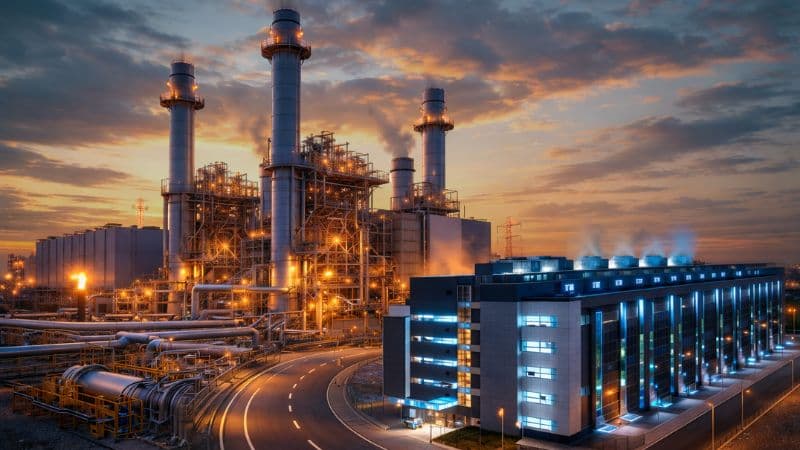
Texas is on track to become the largest data center market in the U.S., and that trajectory is powered by how aggressively the state is expanding gas-fired generation capacity to meet hyperscale and AI demand. Commercial real estate data shows Texas already has around 10–11 GW of data center capacity existing or under construction, putting it nearly level with Northern Virginia, the long-time leader in U.S. data center capacity. That growth is structural, not temporary, and is supported by affordable land, favorable policies, and, critically, the ability to secure power quickly. Building compute infrastructure without power simply is not viable, and Texas is leading because its generation pipeline is matching demand.
The need for electricity due to data centers is becoming one of the largest drivers of grid growth. A recent forecast referenced by multiple industry sources shows power demand from data centers in Texas could exceed 40 GW by 2028, representing a major increase from current levels. That projection reflects not only new server halls but extremely high continuous load profiles that require dispatchable generation rather than intermittent supply alone. As artificial intelligence deployments expand, developers cannot rely on multi-year waits for grid upgrades, making local generation strategy central to project timelines.
Gas-fired generation is scaling in parallel
Texas already produces roughly a quarter of total U.S. marketed natural gas, giving it a structural fuel supply advantage for new power plants and onsite generation. Combined-cycle and simple-cycle gas plants can be built and commissioned far faster than major transmission upgrades, improving reliability for high-demand facilities. Recent reporting indicates that about 40 GW of gas generation projects are being developed in Texas, with a significant share intended to deliver energy directly at or near data center sites, reducing dependence on long transmission queues. That scale signals a coordinated strategy where power infrastructure follows compute load rather than trailing behind it.
Large integrated data centers are increasingly incorporating onsite generation as part of project risk management. Some major tech projects in Texas, including high-profile AI campuses, are planning to operate with onsite gas generation or microgrid schemes to avoid long wait times for grid connections. For example, one AI data center project in Shackelford County is advancing a 1.4 GW microgrid powered by hundreds of natural gas generators to support continuous operation independent of the main grid. This reflects a broader trend where energy strategy is embedded in site selection and project execution rather than treated as an afterthought.
Gas-fired generation supports high-density load because it delivers firm, dispatchable power with strong reliability metrics. Combined-cycle plants typically operate at high-capacity factors and can provide the consistent output needed for next-generation AI workloads. They also contribute to grid stability during peak demand periods, which is critical when a single data center campus can represent a load comparable to a mid-sized city. Wind and solar continue to expand in Texas and contribute to the overall energy mix, but without large-scale storage, they cannot independently meet 24/7 load requirements. Gas fills that reliability gap while renewable capacity grows.
ERCOT’s market structure supports generation growth
Texas’ Independent System Operator, ERCOT, operates an energy-only market that incentivizes generation capacity to respond directly to energy pricing signals. In contrast to capacity markets found in other regions, ERCOT’s design allows generators to move forward with clearer economic expectations when demand forecasts rise. Recent data shows interconnection requests in the ERCOT queue exceeding 230 GW, with a large portion associated with data centers and other high-load projects. This volume illustrates both the scale of anticipated load and the pace at which generation developers must respond.
Because the queue contains far more proposed load than will ultimately materialize, grid planners are focused on improving interconnection processes and forecasting to avoid reliability issues. New protocol changes and interconnection rules are being introduced to manage this growth more predictably. Even with those improvements, large loads like data centers still create complexity, which is one reason onsite and co-located generation is becoming more common. Developers and power providers are working together to reduce risks associated with congested grid access.
ERCOT and the speed advantage

Texas operates under ERCOT’s energy-only market structure, which allows generation to respond directly to price signals rather than relying on traditional capacity payments. As forward demand expectations rise, the economics of new gas plants strengthen. This market design reduces development friction and shortens timelines compared to more regulated regions.
Interconnection demand highlights the scale of anticipated growth. Reports indicate ERCOT’s queue exceeds 200 GW of proposed generation and large load projects combined. While not all projects will move forward, the volume signals intense development pressure and reinforces the need for firm capacity additions.
Developers are increasingly positioning gas plants near emerging data center corridors in North Texas and West Texas. In some cases, onsite or co-located generation is incorporated directly into campus planning. This reduces exposure to transmission delays and gives operators more control over energization schedules.
Harry Crane, Principal Consultant at LVI Associates, puts it clearly:
When you look at the load projections, the constraint is not demand. The constraint is how fast you can deliver reliable megawatts. Gas-fired generation is what closes that gap in Texas.
Where LVI Associates fits
As Texas moves toward becoming the largest data center market in the U.S., the pressure on talent is intensifying. Gas-fired generation projects require experienced power engineers, EPC leaders, grid specialists, environmental consultants and project finance professionals. Data center developers simultaneously need design engineers, commissioning experts, construction directors and energy strategists who understand firm generation integration.
At LVI Associates, we focus exclusively on infrastructure and energy talent. We work closely with power developers, utilities, engineering consultancies and data center operators to secure the specialists delivering this buildout. Our passion for data center recruitment is rooted in understanding how power and digital infrastructure intersect. We do not view compute growth and generation growth separately because the market no longer does.
The acceleration of gas-fired generation in Texas is not just a technical trend. It is a talent story. Companies that secure the right engineers and project leaders will deliver projects on schedule. Those who cannot, will fall behind.
Texas is leading because it can deliver reliable megawatts at scale. The professionals behind those megawatts are what make that leadership possible.